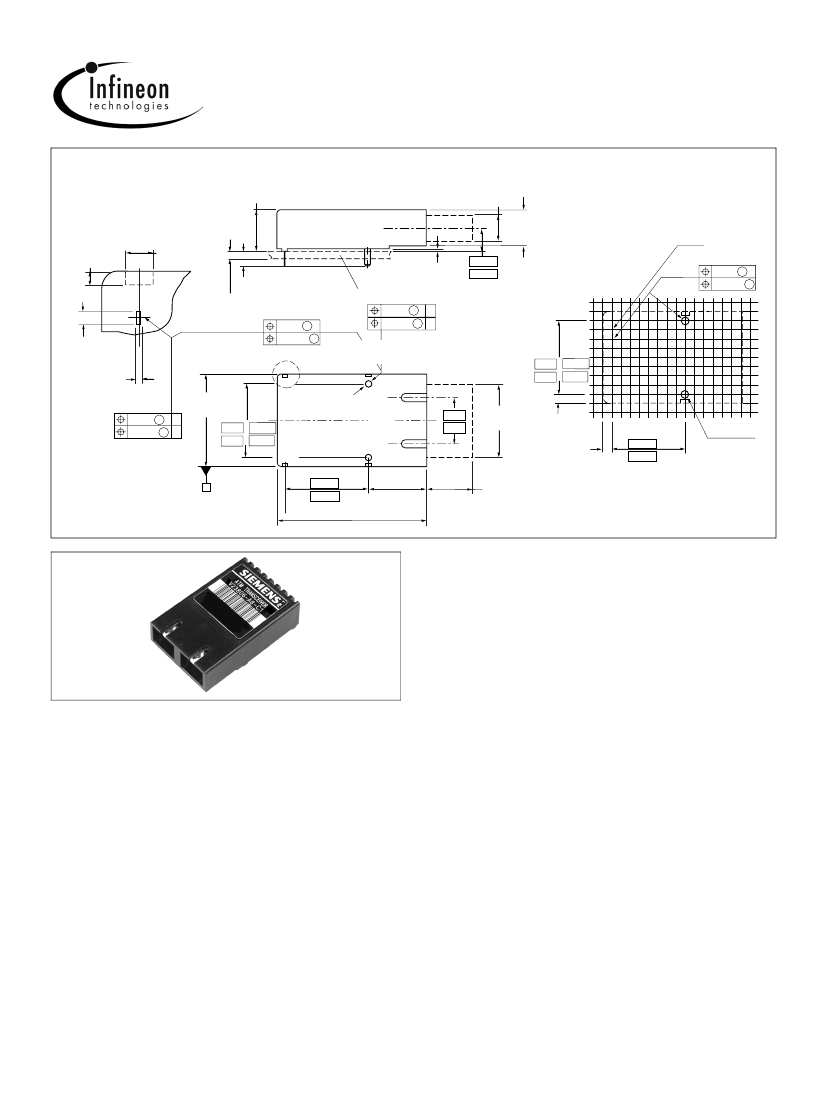
.453 max.
9x (0.8) min.
.032 min.
(0.5) typ.
.020 typ.
(0.25) typ.
.010 typ.
(20鈭?/div>
1
)
.787
鈭?040
q
q
1 2 3 4 5 6 7 8 9
q
q
(2.54)
.100
(2.54)
.100
20.32
.800
(1.9
鹵0.1)
2x
.075
鹵.004
A
20.32
.800
(38.62
鹵0.1
)
1.52
鹵.004
(15.88
鹵0.5
)
.625
鹵.020
(12.6
鹵0.3
)
.496
鹵.012
a. Stud pins are isolated
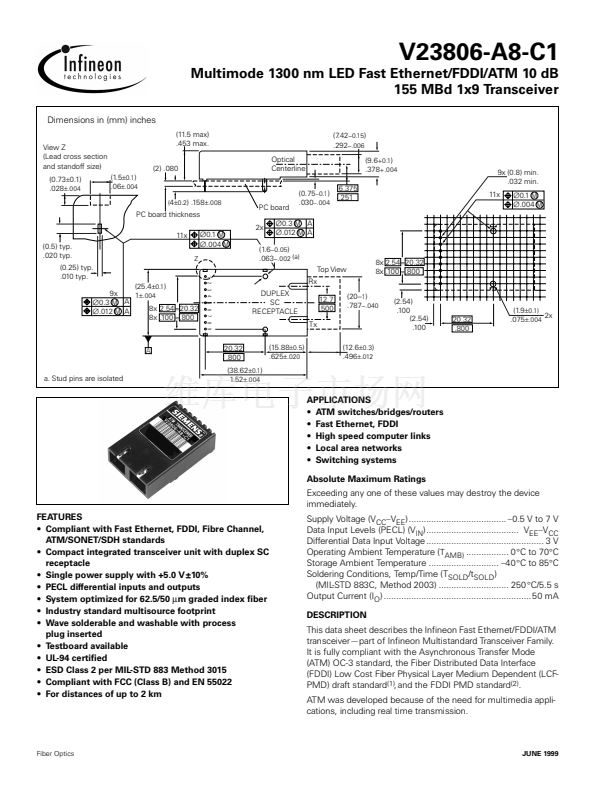
APPLICATIONS
鈥?ATM switches/bridges/routers
鈥?Fast Ethernet, FDDI
鈥?High speed computer links
鈥?Local area networks
鈥?Switching systems
Absolute Maximum Ratings
Exceeding any one of these values may destroy the device
immediately.
FEATURES
鈥?Compliant with Fast Ethernet, FDDI, Fibre Channel,
ATM/SONET/SDH standards
鈥?Compact integrated transceiver unit with duplex SC
receptacle
鈥?Single power supply with +5.0 V鹵10%
鈥?PECL differential inputs and outputs
鈥?System optimized for 62.5/50
碌m
graded index fiber
鈥?Industry standard multisource footprint
鈥?Wave solderable and washable with process
plug inserted
鈥?Testboard available
鈥?UL-94 certified
鈥?ESD Class 2 per MIL-STD 883 Method 3015
鈥?Compliant with FCC (Class B) and EN 55022
鈥?For distances of up to 2 km
Supply Voltage (V
CC
鈥揤
EE
)....................................... 鈥?.5 V to 7 V
Data Input Levels (PECL) (V
IN
)..................................... V
EE
鈥揤
CC
Differential Data Input Voltage ............................................... 3 V
Operating Ambient Temperature (
T
AMB)
................. 0擄C to 70擄C
Storage Ambient Temperature ............................ 鈥?0擄C to 85擄C
Soldering Conditions, Temp/Time (T
SOLD
/t
SOLD
)
(MIL
-STD 883C, Method 2003) ............................ 250擄C/5.5 s
Output Current (I
O
) ........................................................... 50 mA
DESCRIPTION
This data sheet describes the Infineon Fast Ethernet/FDDI/ATM
transceiver鈥攑art of Infineon Multistandard Transceiver Family.
It is fully compliant with the Asynchronous Transfer Mode
(ATM) OC-3 standard, the Fiber Distributed Data Interface
(FDDI) Low Cost Fiber Physical Layer Medium Dependent (LCF-
PMD) draft standard
(1)
, and the FDDI PMD standard
(2)
.
ATM was developed because of the need for multimedia appli-
cations, including real time transmission.
Fiber Optics
JUNE 1999






 INFINEON


 1
1
 2
2
 3
3
