SC16C2552
Dual UART with 16-byte transmit and receive FIFOs
Rev. 03 鈥?20 June 2003
Product data
1. Description
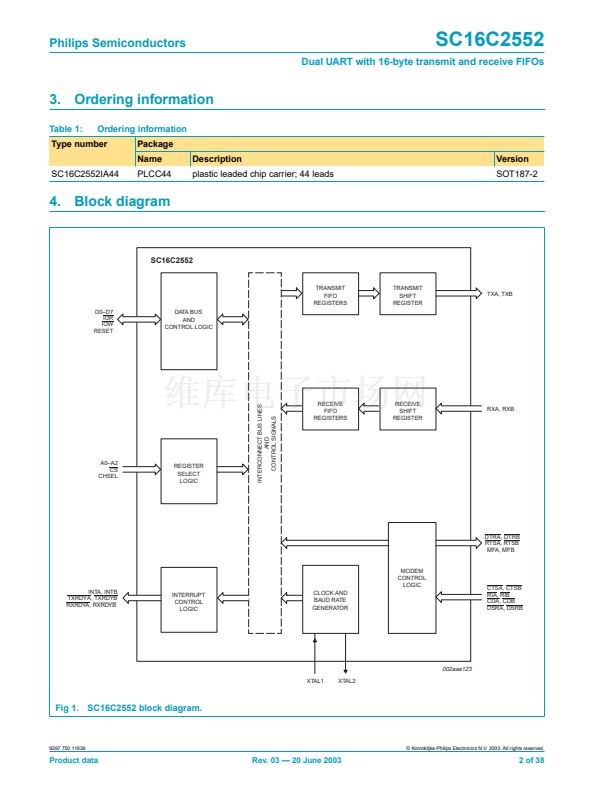
The SC16C2552 is a two channel Universal Asynchronous Receiver and Transmitter
(UART) used for serial data communications. Its principal function is to convert
parallel data into serial data, and vice versa. The UART can handle serial data rates
up to 5 Mbits/s.
The SC16C2552 is pin compatible with the PC16C552 and ST16C2552. It will
power-up to be functionally equivalent to the 16C2450. The SC16C2552 provides
enhanced UART functions with 16 byte FIFOs, modem control interface, DMA mode
data transfer and concurrent writes to control registers of both channels. The DMA
mode data transfer is controlled by the FIFO trigger levels and the RXRDY and
TXRDY signals. On-board status registers provide the user with error indications and
operational status. System interrupts and modem control features may be tailored by
software to meet speci鏗乧 user requirements. An internal loop-back capability allows
on-board diagnostics. Independent programmable baud rate generators are provided
to select transmit and receive baud rates.
The SC16C2552 operates at 5 V, 3.3 V and 2.5 V, and the Industrial temperature
range, and is available in a plastic PLCC44 package.
2. Features
s
s
s
s
s
s
s
s
s
s
s
s
s
s
Industrial temperature range (鈭?0
擄C
to +85
擄C)
5 V, 3.3 V and 2.5 V operation
Pin-to-pin and functionally compatible to PC16C552, ST16C2552
Software compatible with INS8250, NS16C550
Up to 5 Mbits/s data rate at 5 V and 3 V, and 3 Mbits/s at 2.5 V
16-byte transmit FIFO
16-byte receive FIFO with error 鏗俛gs
Independent transmit and receive UART control
Four selectable Receive FIFO interrupt trigger levels; 鏗亁ed XMIT FIFO interrupt
trigger level
Modem control signals (CTS, RTS, DSR, DTR, RI, CD)
DMA operation and DMA monitoring via package I/O pins, TXRDY/RXRDY
UART internal register sections A and B may be written to concurrently
Multi-function output allows more package functions with fewer I/O pins
Programmable character lengths (5, 6, 7, 8), with even, odd, or no parity










 1
1
 2
2
 3
3
 4
4
 5
5
 6
6
 7
7
 8
8
 9
9
 10
10
 11
11
 12
12
 13
13
 14
14
 15
15
 16
16
 17
17
 18
18
 19
19
 20
20
 21
21
 22
22
 23
23
 24
24
 25
25
 26
26
 27
27
 28
28
 29
29
 30
30
 31
31
 32
32
 33
33
 34
34
 35
35
 36
36
 37
37
 38
38
