RESEARCH NEWS
Thin-Film Amorphous Silicon
Position-Sensitive Detectors
By
Jasmine Henry*
and
John Livingstone
Optical position-sensitive detectors are a useful class of sensor with a wide range of
applications in machine control systems, industrial alignment and robotic vision. They
have distinct advantages over most arrayed discrete optical devices in that they can
produce continuous optical signals, and versions based on thin-film amorphous sili-
con are not restricted by crystal growth limits and so have the potential to be fabri-
cated in large area format. Sputter-deposited hydrogenated a-Si also has features such
as excellent adhesion to glass substrates, precise film thickness, and hydrogen content control, which are of some
interest in device design and fabrication.
1. Introduction
Position-sensitive detectors, or PSDs, comprise an impor-
tant class of optical sensor, producing an electrical output,
either voltage or current, which utilizes the lateral photo-
voltaic effect to give a linear relation between the output and
the location of a spot of light impinging on a semiconductor
surface. This phenomenon was first described by Schottky in
1930
[1]
and rediscovered by Wallmark in 1957.
[2]
PSDs are used for a variety of optical applications, such as
machine tool alignment, medical instrumentation, remote
optical alignment, robotic vision, and other applications
requiring precision measurements. Other interesting applica-
tions include telephone information systems,
[3]
surface profil-
ing, angle measurement, rotation monitoring, guidance sys-
tems, and roles where precise automated control is necessary.
PSDs are different to photodiode and other device arrays,
e.g., those formed using charge coupled devices (CCDs), in
that they can provide continuous information with no internal
discontinuities.
[4]
The other advantages of PSDs over CCDs
are that PSDs have better sampling frequencies (10 MHz to
10 kHz compared to 2 kHz) and they are cheaper. CCDs have
the advantage that they are more effective at eliminating the
effects of stray light.
[5]
The wavelength sensitivity of these devices is, like all semi-
conductor optical devices, dependent upon the optical energy
gap of the absorbing material so that a typical silicon-based
single-crystal device has a maximum response in the region of
1000 nm. Our a-Si devices appear to have an optimal response
to white light (peak wavelength 690 nm), which corresponds
to an effective energy gap in the region of 1.8 eV. Light inten-
sity does not appear to affect the linearity of device output,
however, the magnitude of the response is directly related to
the input power while operating below optical saturation. The
devices, however, appear to lose linearity close to the contacts
and this is attributed to edge effects related to electric field
distributions.
[4]
Typical light saturation for silicon-based PSDs is around
3 W/cm
2
and above this figure the photocurrent has a magni-
tude such that the voltage drop across the sheet resistance is
so large that it equals reasonable values of reverse bias across
the device in photodiode mode. At this point the p鹵n junction
will be forward biased and hence the PSD no longer functions
in this mode. Our devices have shown the best linearities in
photovoltaic mode, with no advantage being gained in photo-
diode mode implying that we are approaching saturation with
some of our optical sources. In a photodiode, saturation
means that the production of photocurrent is saturated and
can no longer increase with increasing light intensity. This
leads to an accumulation of charge in the diode which slows it
down. To remove these charges after the light is turned off, a
recovery time is required.
[5]
鹵
[*]
2. Mechanisms of Position-Sensitive Detector
Operation
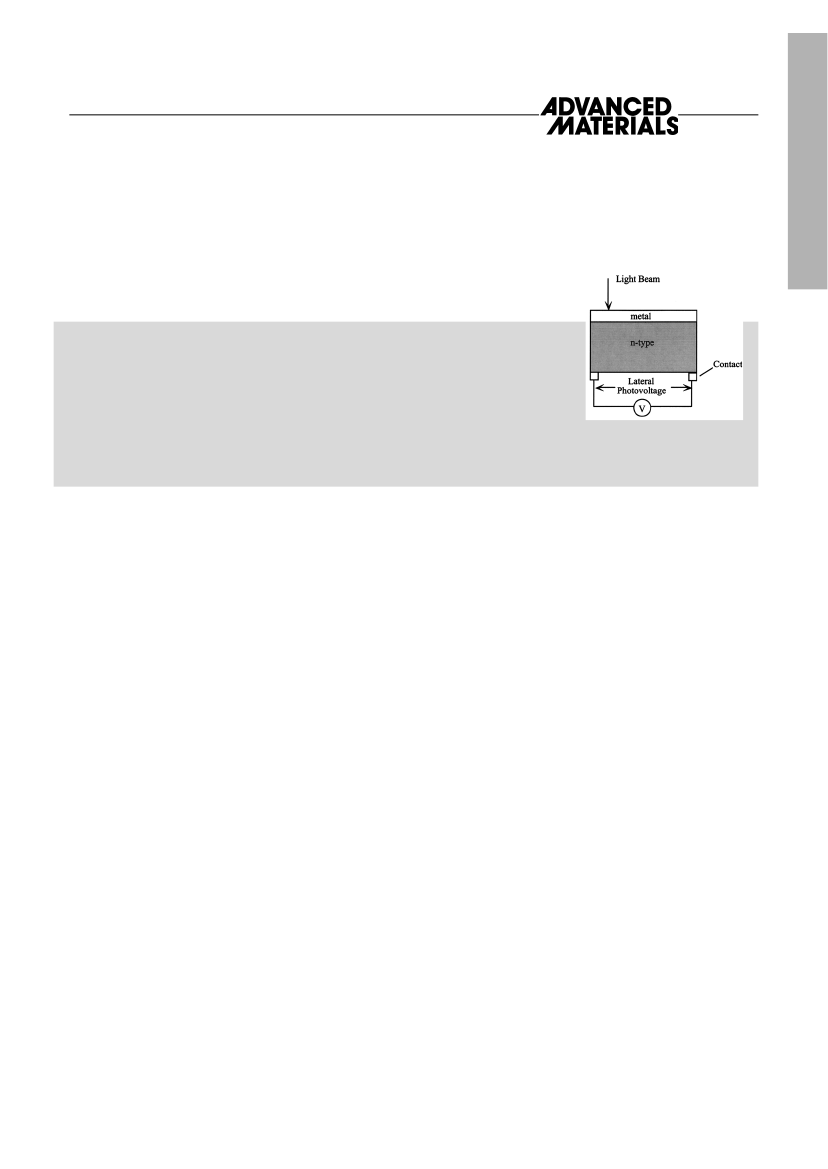
The simplest model of a PSD is that of a crystal-based
device with a highly conducting top layer on a lower conduc-
tivity substrate, with appropriately placed contacts. They can
1
Dr. J. Henry, Dr. J. Livingstone
Department of Electrical and Electronic Engineering
University of Western Australia
35 Stirling Highway, Crawley, W.A. 6009 (Australia)
E-mail: jasmine@ee.uwa.edu.au
Adv. Mater.
2001,
13,
No. 12鹵13, Julyl 4
脫
WILEY-VCH Verlag GmbH, D-69469 Weinheim, 2001
0935-9648/01/12鹵1307-01 $ 17.50+.50/0









 1
1
 2
2
 3
3
 4
4
