鈥?/div>
Low-noise Low Drop Out Voltage Regulator
2.8V Fixed Output Voltage
3V to 5.5V Supply Operation
130 mA Maximum Load Current
Power-down Mode Consumption Less Than 1 碌A(chǔ)
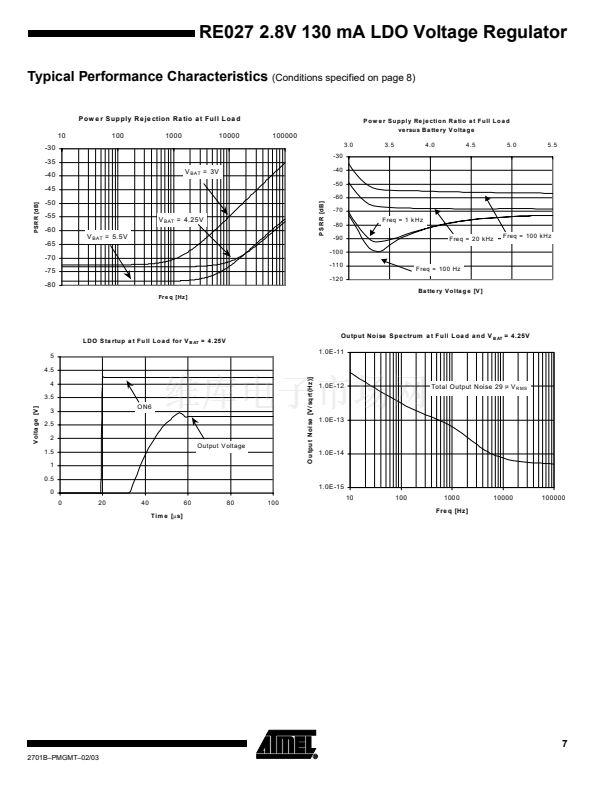
More Than 70 dB (Typical) PSRR at 1 kHz
29 碌V
RMS
Output Noise
0.35 碌m CMOS Technology
Typical Application: Radio Section Supply in Mobile Terminals
Description
RE027 is a Low Drop Out (LDO) voltage regulator macrocell with a fixed 2.8V output
voltage, rated for loads up to 130 mA. It is designed to be integrated with other analog
cells, digital logic, microcontrollers, DSP cores and memory blocks into system-on-
chip products.
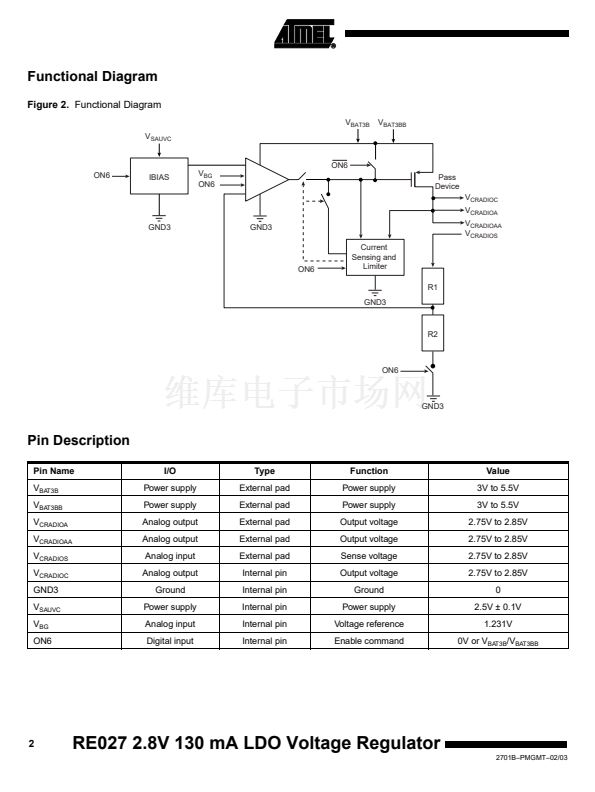
The circuit consists of a PMOS pass device, an error amplifier and a feedback resis-
tive network, sized to achieve the required closed loop gain. These blocks make up
the regulating loop. An over-current and short circuit protection circuit has been
included to limit the output current delivered by the regulator, thus avoiding destruction
in case of a short circuit.
An external reference voltage (bandgap voltage) is necessary for correct functionality.
The target reference voltage is 1.231V delivered, for example, by BG019. Double pads
on the supply voltage V
BAT3B
/V
BAT3BB
and output voltage V
CRADIOA
/V
CRADIOAA
are used
to reduce the total output resistance. Current reference is generated inside the cell
through a circuit supplied by a 2.5V 鹵 0.1V regulated input voltage on V
SAUVC
. Remote
sense terminal V
CRADIOS
provides regulation at the load by connecting it to the output
terminal near a critical point to improve performance of the regulator (e.g., connecting
them at the package pin by double-bonding, thus avoiding the bonding resistance
influence). A capacitor of 2.2 碌F connected from V
CRADIOA
/V
CRADIOAA
to ground is
needed as external compensation.
Figure 1.
Symbol
(1)
vbat3b
vbat3bb
Embedded ASIC
Macrocell:
Power
Management for
Mobile
Terminals (PM)
RE027
Fixed 2.8V
130 mA
Low-noise LDO
Voltage
Regulator
vsauvc
vbg
vcradioa
vcradioaa
on6
vcradios
vcradioc
gnd3
Note:
1. Pin names are written as they appear on the user screen when the symbol is
opened in the design tool environment.
Rev. 2701B-PMGMT鈥?2/03
1








 1
1
 2
2
 3
3
 4
4
 5
5
 6
6
 7
7
 8
8
 9
9
