鈥?/div>
PI74ALVCH162601 is designed for low voltage operation
V
CC
= 2.3V to 3.6V
Hysteresis on all inputs
Typical V
OLP
(Output Ground Bounce)
< 0.8V at V
CC
= 3.3V, T
A
= 25擄C
Typical V
OHV
(Output V
OH
Undershoot)
< 2.0V at V
CC
= 3.3V, T
A
= 25擄C
Bus Hold retains last active bus state during 3-STATE,
eliminating the need for external pullup resistors
Industrial operation at 聳40擄C to +85擄C
Packages available:
聳 56-pin 240 mil wide plastic TSSOP (A)
聳 56-pin 300 mil wide plastic SSOP (V)
Product Description
Pericom Semiconductor鈥檚 PI74ALVCH series of logic circuits are
produced in the Company鈥檚 advanced 0.5 micron CMOS technology,
achieving industry leading speed.
The PI74ALVCH162601 uses D-type latches and D-type flip-flops
with 3-state outputs to allow data flow in transparent, latched, and
clocked modes.
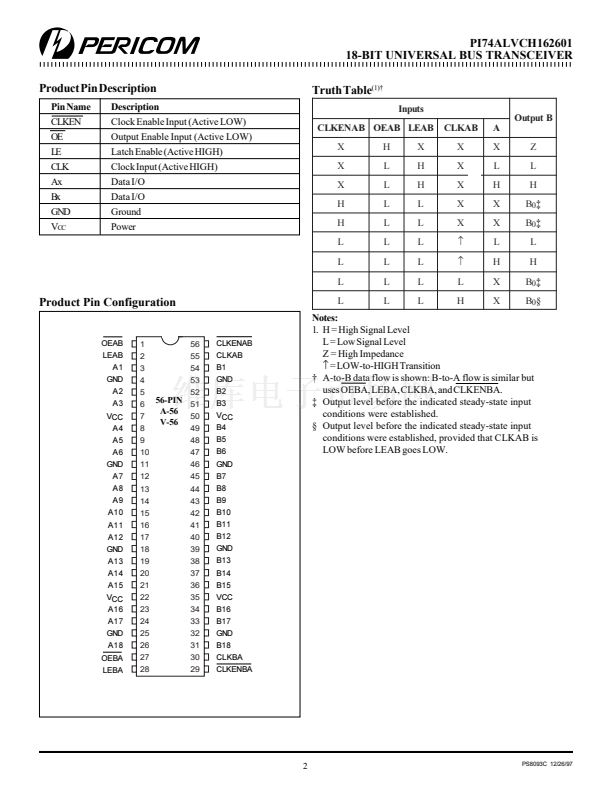
Data flow in each direction is controlled by Output Enable (OEAB
and OEBA), Latched Enable (LEAB and LEBA), and Clock (CLKAB
and CLKBA) inputs. The clock can be controlled by the Clock Enable
(CLKENAB and CLKENBA) inputs. For A-to-B data flow, the device
operates in the transparent mode when LEAB is HIGH. When LEAB
is LOW, the A data is latched if CLKAB is held at a high or low logic
level. If LEAB is low, the A-bus is stored in the latch/flip-flop on the
low-to-high transition of CLKAB. When OEAB is low, the outputs
are active. When OEAB is HIGH, the outputs are in the high-
impedance state.
Data flow for B to A is similar to that of A to B but uses OEBA, LEBA,
CLKBA, and CLKENBA.
Logic Block Diagram
To reduce overshoot and undershoot, the B-port outputs include
26鈩?series resistors.
To ensure the high-impedance state during power up or power
down, OE should be tied to V
CC
through a pull-up resistor; the
minimum value of the resistor is determined by the current-sinking
capability of the driver.
The PI74ALVCH162601 has 鈥淏us Hold鈥?which retains the data
input鈥檚 last state whenever the data input goes to high-impedance
preventing 鈥渇loating鈥?inputs and eliminating the need for pullup/
down resistors.
1
PS8093C 12/26/97









 1
1
 2
2
 3
3
 4
4
 5
5
