NTE2764
Integrated Circuit
NMOS, 64K Erasable EPROM, 200ns
Description:
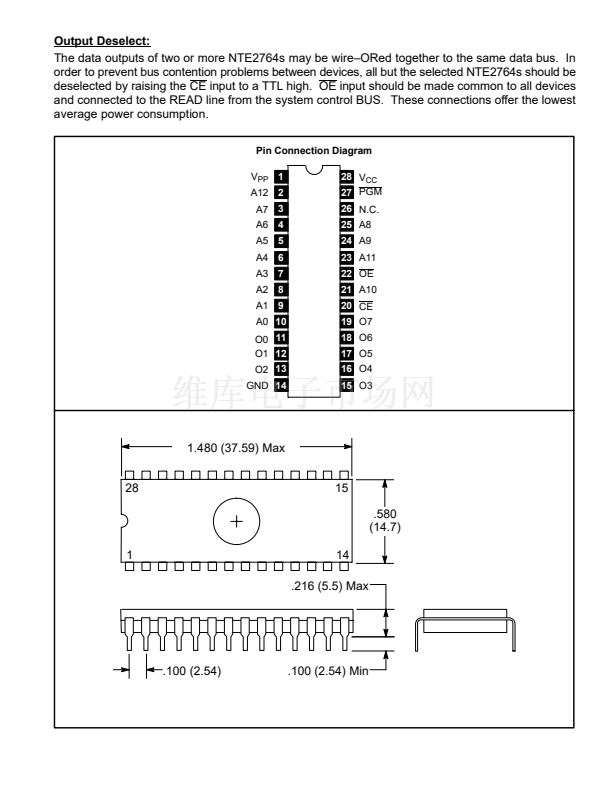
The NTE2764 is a 65,536鈥揵it (8192 X 8 bit) Ultraviolet Erasable and Electrically Programmable
Read鈥揙nly Memory (EPROM) in a 28鈥揕ead DIP type package which operates from a single +5V sup-
ply, making it ideal for microprocessor applications. It features an output enable control and offers
a standby mode with an attendant 67% savings in power consumption.
A distinctive feature of the NTE2764 is a separate output control, output enable (OE) from the chip
enable control (CE). The OE control eliminates bus contention in multiple鈥揵us microprocessor sys-
tems. The NTE2764 features fast, simple one鈥損ulse programming controlled by TTL鈥搇evel signals.
Total programming time for all 65,536 bits is 420 seconds.
Features:
D
Ultraviolet Erasable and Electrically Programmable
D
Access Time: 250ns Max
D
Single Location Programming
D
Programmable with Single Pulse
D
Low Power Dissipation: 150mA Max (Active Current)
50mA Max (Standby Current)
D
Input/Output TTL Compatible for Reading and Programming
D
Single +5V Power Supply
D
Three鈥揝tate Outputs
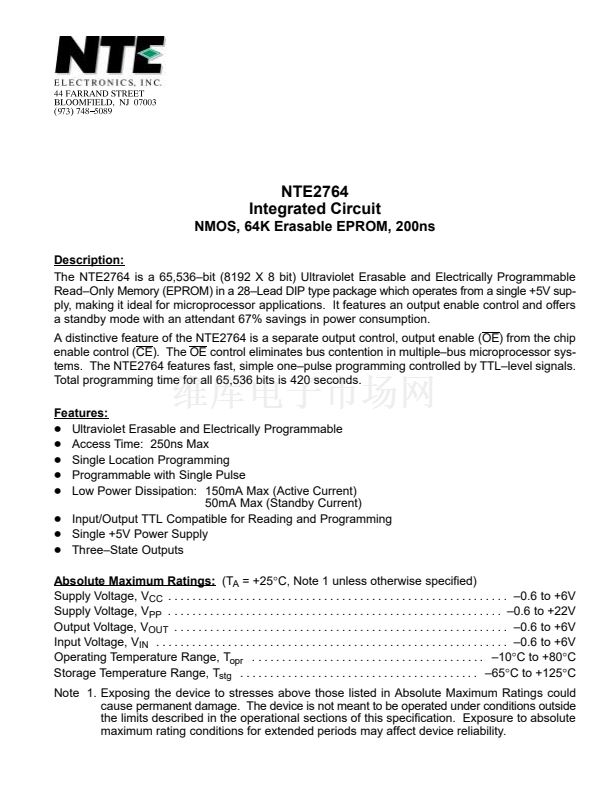
Absolute Maximum Ratings:
(T
A
= +25擄C, Note 1 unless otherwise specified)
Supply Voltage, V
CC
. . . . . . . . . . . . . . . . . . . . . . . . . . . . . . . . . . . . . . . . . . . . . . . . . . . . . . . . . 鈥?.6 to +6V
Supply Voltage, V
PP
. . . . . . . . . . . . . . . . . . . . . . . . . . . . . . . . . . . . . . . . . . . . . . . . . . . . . . . . 鈥?.6 to +22V
Output Voltage, V
OUT
. . . . . . . . . . . . . . . . . . . . . . . . . . . . . . . . . . . . . . . . . . . . . . . . . . . . . . . . 鈥?.6 to +6V
Input Voltage, V
IN
. . . . . . . . . . . . . . . . . . . . . . . . . . . . . . . . . . . . . . . . . . . . . . . . . . . . . . . . . . . 鈥?.6 to +6V
Operating Temperature Range, T
opr
. . . . . . . . . . . . . . . . . . . . . . . . . . . . . . . . . . . . . . . 鈥?0擄C to +80擄C
Storage Temperature Range, T
stg
. . . . . . . . . . . . . . . . . . . . . . . . . . . . . . . . . . . . . . . . 鈥?5擄C to +125擄C
Note 1. Exposing the device to stresses above those listed in Absolute Maximum Ratings could
cause permanent damage. The device is not meant to be operated under conditions outside
the limits described in the operational sections of this specification. Exposure to absolute
maximum rating conditions for extended periods may affect device reliability.








 1
1
 2
2
 3
3
 4
4
 5
5
