The NTE21256 is a 262,144 word by 1鈥揵it dynamic Random Access Memory. This 5V鈥搊nly component
is fabricated with N鈥揷hannel silicon gate technology.
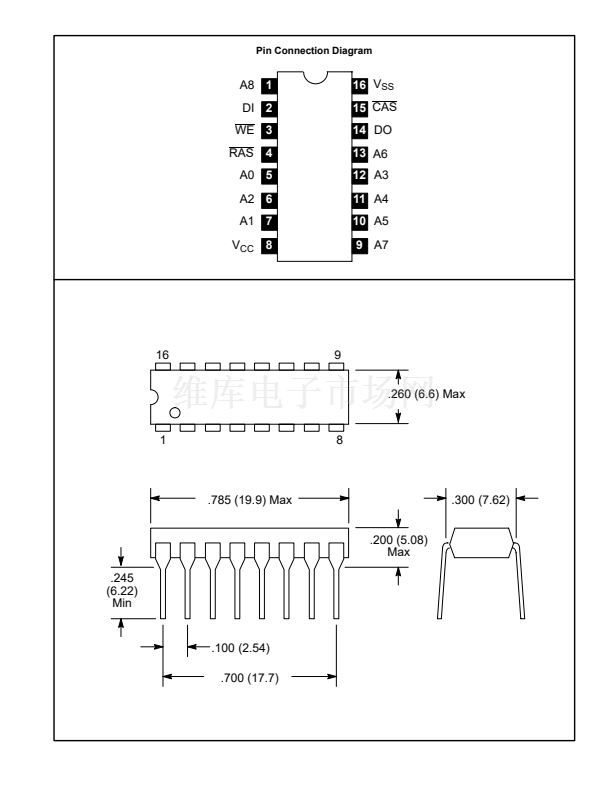
Nine multiplexed address inputs permit the NTE21256 to be packaged in an industry standard
16鈥揕ead DIP package. Features of this device include single power supply with
tolerance, on鈥?/div>
chip address, date registers which eliminate the need for interface registers, and fully TTL compatible
inputs and outputs, including clocks.
In addition to the usual read, write, and read鈥搈odify鈥搘rite cycles, the NTE21256 is capable of early
and late write cycles, RAS鈥搊nly refresh, and hidden refresh. Common I/O capability is given by using
early write operation.
The NTE21256 also features page mode which allows high鈥搒peed random access of bits in the same
row.
Features:
D
262,144 x 1鈥揃it Organization
D
Single +5V Supply,
鹵10%
Tolerance
D
Low Power Dissipation:
鈥?85mW active (Max)
鈥?8mW standby (Max)
D
Access Time: 150ns
D
Cycle Time: 260ns
D
All Inputs and Outputs TTL Compatible
D
On鈥揅hip Substrate Bias Generator
D
Three鈥揝tate Data Output
D
Read, Write, Read鈥揗odify鈥揥rite, RAS鈥揙nly鈥揜efresh, Hidden Refresh
D
Common I/O Capability using 鈥淓arly Write鈥?Operation
D
Page Mode Read and Write, Read鈥揥rite
D
256 Refresh Cycles with 4ms Refresh Period
Absolute Maximum Ratings:
(Note 1)
Operating Temperature Range, T
opr
. . . . . . . . . . . . . . . . . . . . . . . . . . . . . . . . . . . . . . . . . . . 0擄 to +70擄C
Storage Temperature Range, T
stg
. . . . . . . . . . . . . . . . . . . . . . . . . . . . . . . . . . . . . . . . . . 鈥?5擄 to +150擄C
Voltage on any pin relative to V
SS
. . . . . . . . . . . . . . . . . . . . . . . . . . . . . . . . . . . . . . . . . . . . . . . 鈥? to +7V
Power Dissipation, P
D
. . . . . . . . . . . . . . . . . . . . . . . . . . . . . . . . . . . . . . . . . . . . . . . . . . . . . . . . . . . . . . 1W
Data Out Current (Short Circuit) . . . . . . . . . . . . . . . . . . . . . . . . . . . . . . . . . . . . . . . . . . . . . . . . . . . . 50mA
Note 1. Stresses above those listed under 鈥淎bsolute Maximum Ratings鈥?may cause permanent
damage to the device. Exposure to absolute maximum rating conditions for extended periods
may affect device reliability.







 1
1
 2
2
 3
3
 4
4
 5
5
 6
6
