NEW PRODUCTS 5
INFRARED TRANSCEIVER MODULE
NL1100/NL1000
Masahiko Kawaratani
Development Background
Portable information products such as
notebook PCs, PDAs, and digital still
cameras have increasingly become
widespread in recent years. Conventionally,
cables have been used to transfer data among
these systems, but demand for infrared
communication that can transmit data at high
speeds without cable connection has grown.
Because infrared communication was not
regulated by standards or laws in each
country, an organization called IrDA
(Infrared Data Association) was established
in response to the demand for a de facto
standard.
NEC has participated in IrDA from the
very
beginning
and
developed
semiconductor devices necessary for IrDA.
NEC鈥檚 latest products are the NL1100
infrared transceiver module, which conforms
to the IrDA1.0/1.1 standard, and the NL1000
low-power-consumption, super-small-
package infrared transceiver module, which
conforms to the IrDA1.0 standard.
This article introduces these new products
(refer to Photograph 1).
Features of Infrared Data Communi-
cation Technology
鈥?High safety
鈥?Requires no cable
鈥?Small, lightweight, low cost, and low
power consumption
鈥?High data communication speed
鈥?Not fettered by country-specific
regulations under international mobile
communication environment
鈥?High confidentiality/security
Photo 1 NL1100/NL1100L/NL1000
Product Outline
1. NL1100
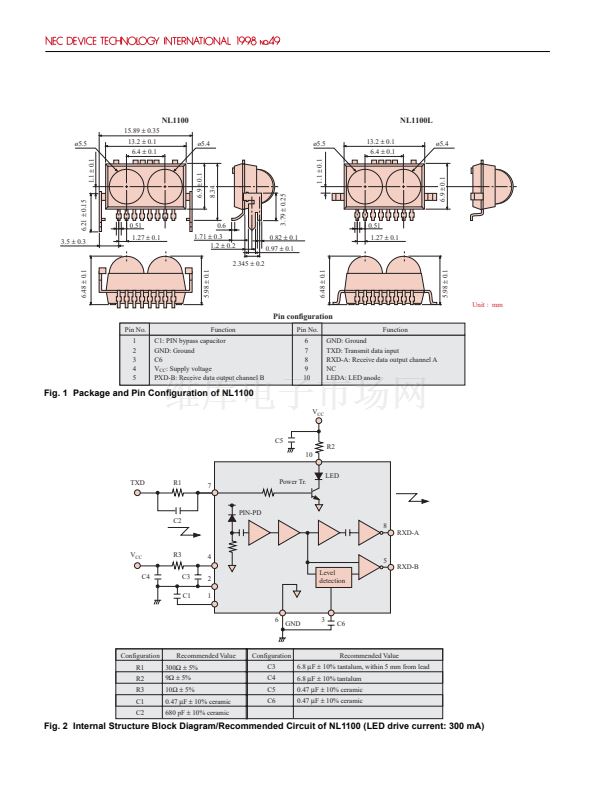
Figure 1 shows the package and pin
configuration of the NL1100, and Figure 2
shows its internal block diagram and
recommended external circuit. The NL1100
integrates a high-speed, high-power infrared
LED, high-speed high-sensitivity PIN
photodiode, and LED driver circuit and
receiver circuit on a single chip housed in a
mold package. Using a 5-V supply voltage,
this infrared transceiver module can be easily
interfaced with peripheral devices. In
addition, the power consumption is low with
the LED drive current standing at 300 mA
at 4 Mbps and 1 m.
To enhance the light emission and
reception efficiency, the converging lens is
molded in the package by using a package
molding resin. This package molding resin
is capable of cutting visible light, so that the
NL1100 is effectively protected from the
adverse influences of sunlight and lamplight.
By using this module, an infrared
communication port can be easily created
without the inconvenience of having to
handle discrete components such as LEDs
and photodiodes.
It was confirmed that the NL1100 can be
connected to the PC87108 Infrared
Controller of National Semiconductor (NS),
the SuperI/O FDC37C669 of Standard
Microsystems Corporation (SMC), and
NEC鈥檚 NZFIRL ASIC core.
Table 1 shows the absolute maximum
ratings of this product. Table 2 shows the
recommended operating conditions, and
Table 3 shows the major specifications.
Features
鈥?IrDA1.0/1.1-compliant
鈥?Transmission rate
擄
Channel A: 2.4kbps to 115.2kbps
擄
Channel B: 0.576Mbps to 4.0Mbps
鈥?Transmission distance: 1cm to 1m
鈥?Low power consumption: ILED: 300mA
TYP.
鈥?Excellent mutual connectability with
controllers of NEC, NS, and SMC
鈥?EMI-shielded case: Option
鈥?Infrared reflow soldering: Once (peak
temperature: 235擄C/10 seconds, preheat
temperature: 210擄C/30 seconds)
Published May 1998
Microwave and Optical Devices Engineering Department, Semiconductor Solution Engineering Division








 1
1
 2
2
 3
3
 4
4
 5
5
