鈩?/div>
interface. The
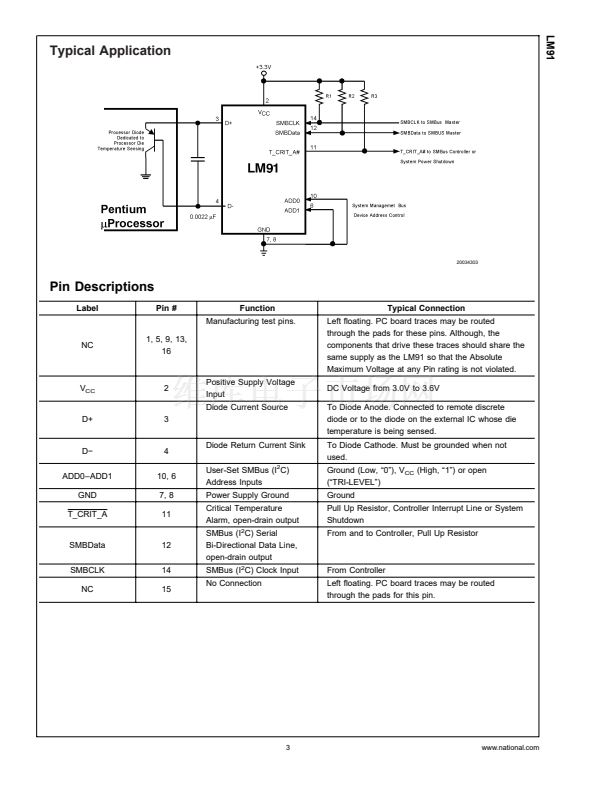
LM91 senses its own temperature as well as the tempera-
ture of a target IC with a diode junction, such as a Pentium
廬
II processor or a diode connected 2N3904. A diode junction
(semiconductor junction) is required on the target IC鈥檚 die. A
host can query the LM91 at any time to read the temperature
of this diode as well as the temperature state of the LM91
itself. A T_CRIT_A interrupt output becomes active when the
temperature is greater than a programmable comparator
limit, T_CRIT.
The host can program as well as read back the state of the
T_CRIT register. Power up default values for T_CRIT are as
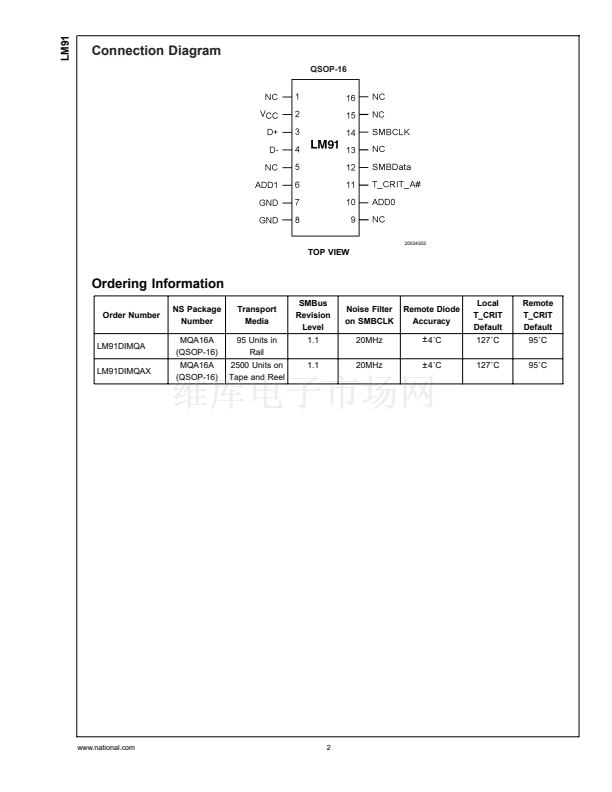
shown in the ordering information table. Three state logic
inputs allow two pins (ADD0, ADD1) to select up to 9 SMBus
address locations for the LM91.
n
Register readback capability
n
7 bit plus sign temperature data format
n
2 address select lines enable 9 LM91s to be connected
to a single bus
Key Specifications
j
Supply Voltage
j
Supply Current
j
Local Temperature Accuracy
j
Remote Diode Temperature Accuracy
3.0V - 3.6V
1 mA (max)
鹵
1.0藲C (typ)
鹵
4藲C (max)
鹵
6藲C (max)
+60藲C to +100藲C
0藲C to +125藲C
Applications
n
n
n
n
n
System Thermal Management
Personal Computers
Electronic Test Equipment
Office Electronics
HVAC
Features
n
Directly senses die temperature of remote ICs
n
Senses temperature of remote diodes
n
SMBus compatible interface, supports SMBus Timeout
Simplified Block Diagram
20034301
#
Indicates Active Low (鈥漀OT鈥?
SMBus
鈩?/div>
is a trademark of the Intel Corporation.
Pentium
廬
II processor is a registered trademark of the Intel Corporation.
I2C
廬
is a registered trademark of the Philips Corporation.
漏 2001 National Semiconductor Corporation
DS200343
www.national.com








 1
1
 2
2
 3
3
 4
4
 5
5
 6
6
 7
7
 8
8
 9
9
 10
10
 11
11
 12
12
 13
13
 14
14
