IBM43RCLNA1116
Datasheet
SiGe 1800 MHz DCS Low-Noise Amplifier with Gain Control
Features
鈥?1805-1880 MHz operation for DCS appli-
cations
鈥?Single 2.8 V, low current power require-
ment
鈥?Selectable gain: 0dB, 19dB, or 25dB
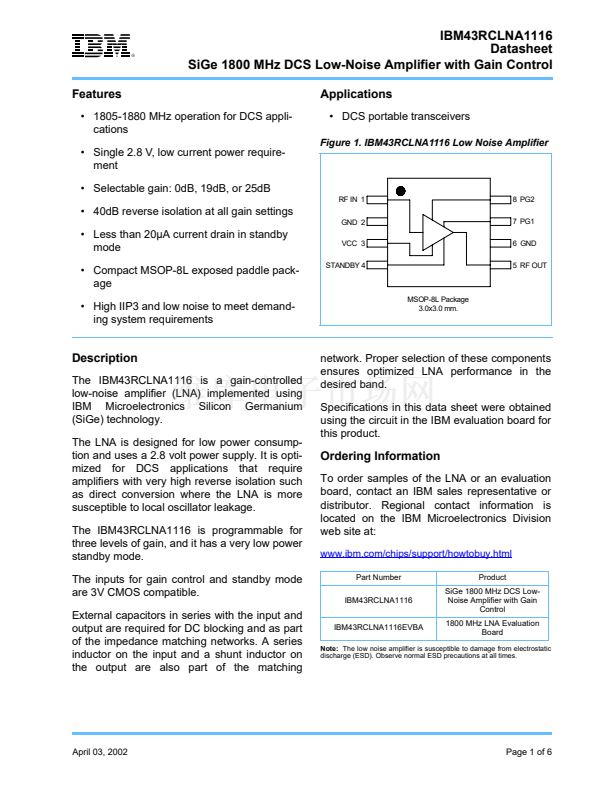
RF IN 1
8 PG2
7 PG1
6 GND
5 RF OUT
Applications
鈥?DCS portable transceivers
Figure 1. IBM43RCLNA1116 Low Noise Amplifier
鈥?40dB reverse isolation at all gain settings
GND 2
鈥?Less than 20碌A current drain in standby
mode
鈥?Compact MSOP-8L exposed paddle pack-
age
鈥?High IIP3 and low noise to meet demand-
ing system requirements
VCC 3
STANDBY 4
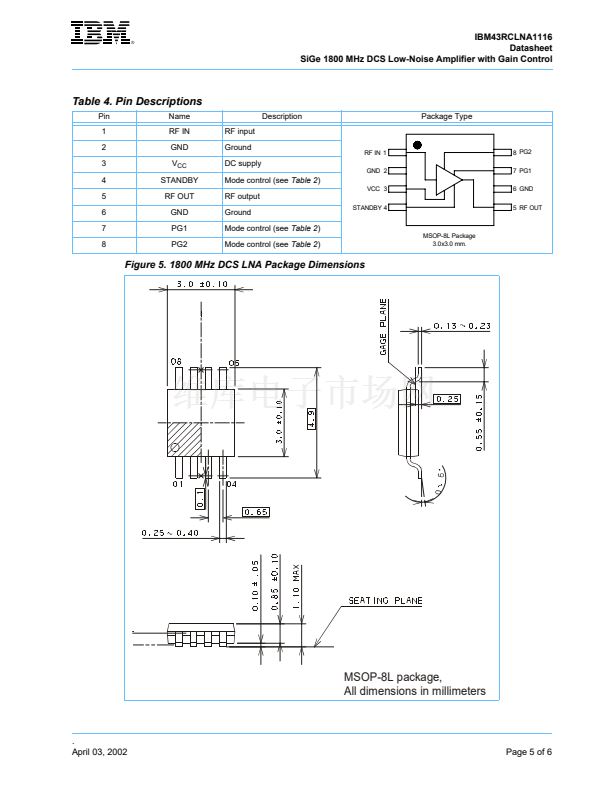
MSOP-8L Package
3.0x3.0 mm.
Description
The IBM43RCLNA1116 is a gain-controlled
low-noise amplifier (LNA) implemented using
IBM Microelectronics Silicon Germanium
(SiGe) technology.
The LNA is designed for low power consump-
tion and uses a 2.8 volt power supply. It is opti-
mized for DCS applications that require
amplifiers with very high reverse isolation such
as direct conversion where the LNA is more
susceptible to local oscillator leakage.
The IBM43RCLNA1116 is programmable for
three levels of gain, and it has a very low power
standby mode.
The inputs for gain control and standby mode
are 3V CMOS compatible.
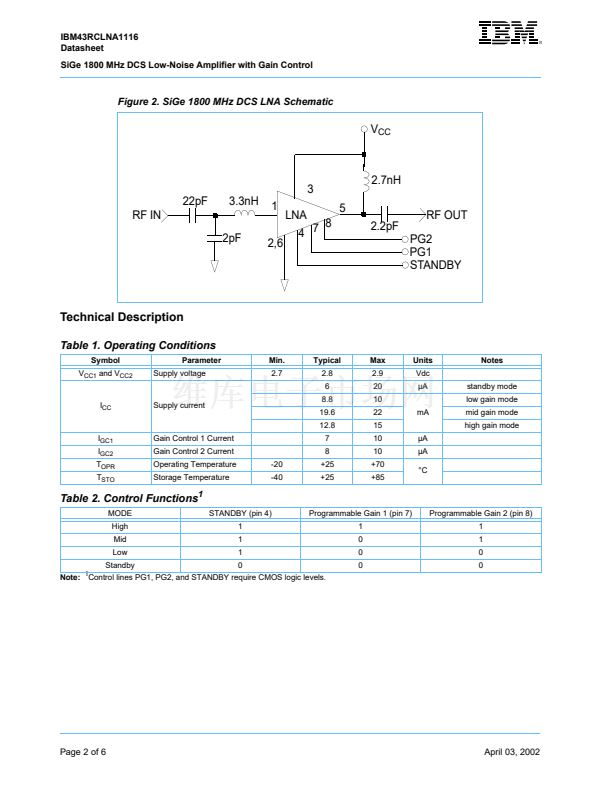
External capacitors in series with the input and
output are required for DC blocking and as part
of the impedance matching networks. A series
inductor on the input and a shunt inductor on
the output are also part of the matching
network. Proper selection of these components
ensures optimized LNA performance in the
desired band.
Specifications in this data sheet were obtained
using the circuit in the IBM evaluation board for
this product.
Ordering Information
To order samples of the LNA or an evaluation
board, contact an IBM sales representative or
distributor. Regional contact information is
located on the IBM Microelectronics Division
web site at:
www.ibm.com/chips/support/howtobuy.html
Part Number
IBM43RCLNA1116
Product
SiGe 1800 MHz DCS Low-
Noise Amplifier with Gain
Control
1800 MHz LNA Evaluation
Board
IBM43RCLNA1116EVBA
Note:
The low noise amplifier is susceptible to damage from electrostatic
discharge (ESD). Observe normal ESD precautions at all times.
April 03, 2002
Page 1 of 6








 1
1
 2
2
 3
3
 4
4
 5
5
 6
6
