鈥?/div>
Fast clock speed: 250, 200, and 167 MHz
Provide high-performance 3-1-1-1 access rate
Fast access time: 2.7, 3.0 and 3.5 ns
Optimal for depth expansion
Single 3.3V 鈥?% and +5% power supply V
DD
Separate V
DDQ
for 3.3V or 2.5V
Common data inputs and data outputs
Byte Write Enable and Global Write control
Chip enable for address pipeline
Address, data, and control registers
Internally self-timed Write Cycle
Burst control pins (interleaved or linear burst
sequence)
Automatic power-down for portable applications
High-density, high-speed packages
JTAG boundary scan for BGA packaging version
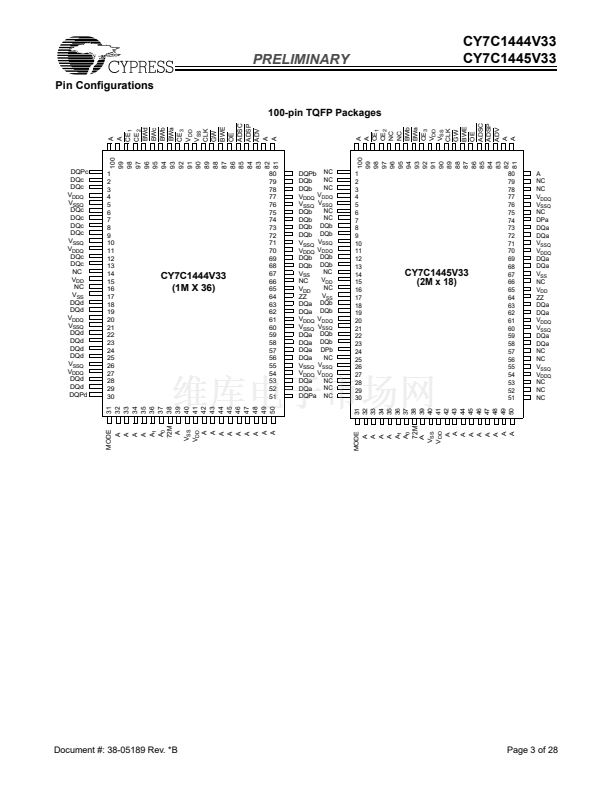
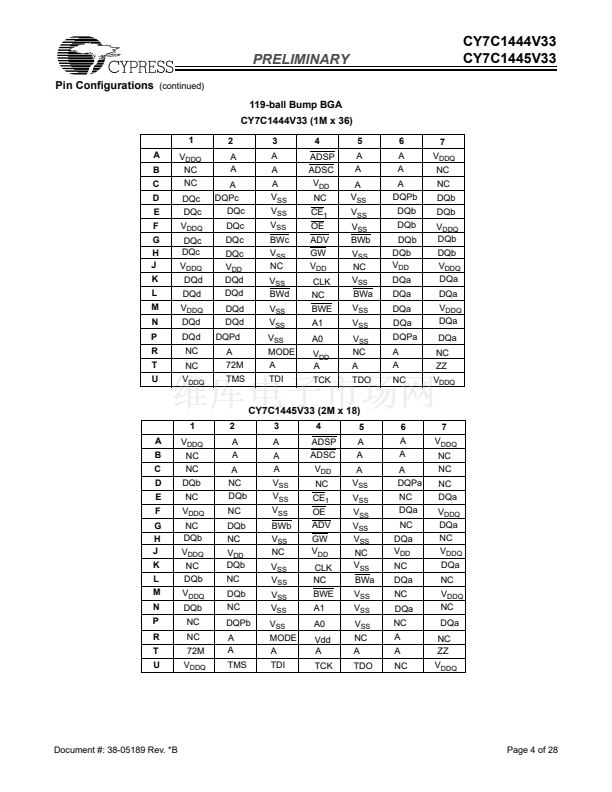
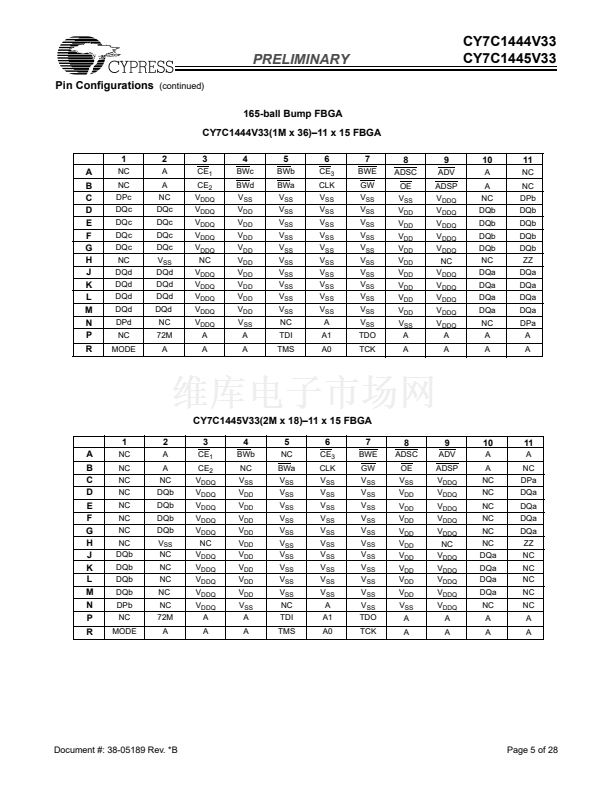
Available in 119-ball bump BGA,165-ball FBGA and
100-pin TQFP packages (CY7C1444V33 and
CY7C1445V33)
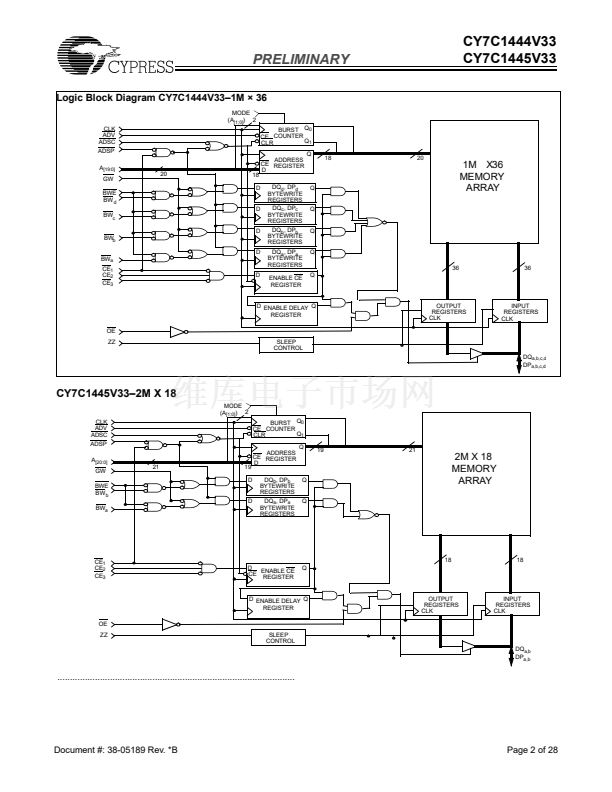
registers controlled by a positive-edge-triggered Clock Input
(CLK). The synchronous inputs include all addresses, all data
inputs, address-pipelining Chip Enable (CE), burst control
inputs (ADSC, ADSP, and ADV), write enables (BWa, BWb,
BWc, BWd and BWE), and Global Write (GW).
Asynchronous inputs include the Output Enable (OE) and
burst mode control (MODE). The data (DQ
a,b,c,d
) and the data
parity (DP
a,b,c,d
) outputs, enabled by OE, are also
asynchronous.
DQ
a,b,c,d
and DP
a,b,c,d
apply to CY7C1444V33, and DQ
a,b
and
DP
a,b
apply to CY7C1445V33. a, b, c, d each are eight bits
wide in the case of DQ and 1 bit wide in the case of DP.
Addresses and chip enables are registered with either
Address Status Processor (ADSP) or Address Status
Controller (ADSC) input pins. Subsequent burst addresses
can be internally generated as controlled by the Burst Advance
Pin (ADV).
Address, data inputs, and write controls are registered on-chip
to initiate self-timed WRITE cycle. WRITE cycles can be one
to four bytes wide as controlled by the write control inputs.
Individual byte write allows individual byte to be written. BWa
controls DQa and DPa. BWb controls DQb and DPb. BWc
controls DQc and DPd. BWd controls DQ and DPd. BWa,
BWb, BWc, BWd can be active only with BWE being LOW. GW
being LOW causes all bytes to be written. WRITE
pass-through capability allows written data available at the
output for the immediately next READ cycle. This device also
incorporates pipelined enable circuit for easy depth expansion
without penalizing system performance.
The CY7C1444V33/CY7C1445V33 are both double-cycle
deselect parts.All inputs and outputs of the CY7C1444V33,
CY7C1445V33 are JEDEC-standard JESD8-5-compatible.
Functional Description
The Cypress Synchronous Burst SRAM family employs
high-speed, low-power CMOS designs using advanced
single-layer polysilicon, triple-layer metal technology. Each
memory cell consists of six transistors.
The CY7C1444V33 and CY7C1445V33 SRAMs integrate
1,048,576 x 36/2,097,152 x18 SRAM cells with advanced
synchronous peripheral circuitry and a two-bit counter for
internal burst operation. All synchronous inputs are gated by
Selection Guide
[1]
CY7C1444V33
CY7C1445V33
-300
Maximum Access Time
Maximum Operating Current
Maximum CMOS Standby Current
Note:
1. Shaded areas contain advance information.
CY7C1444V33
CY7C1445V33
-250
2.7
TBD
TBD
CY7C1444V33
CY7C1445V33
-200
3.0
TBD
TBD
CY7C1444V33
CY7C1445V33
-167
Unit
3.5
TBD
TBD
ns
mA
mA
2.3
Com鈥檒
TBD
TBD
Cypress Semiconductor Corporation
Document #: 38-05189 Rev. *B
鈥?/div>
3901 North First Street
鈥?/div>
San Jose, CA 95134
鈥?/div>
408-943-2600
Revised November 13, 2002








 1
1
 2
2
 3
3
 4
4
 5
5
 6
6
 7
7
 8
8
 9
9
 10
10
 11
11
 12
12
 13
13
 14
14
 15
15
 16
16
 17
17
 18
18
 19
19
 20
20
 21
21
 22
22
 23
23
 24
24
 25
25
 26
26
 27
27
 28
28
