鈥?/div>
Fast access times: 2.5 ns, 3.0 ns, and 3.5 ns
Fast clock speed: 225, 200, 166, and 150 MHz
Fast OE access times: 2.5 ns, 3.0 ns, and 3.5 ns
Optimal for depth expansion (one cycle chip deselect
to eliminate bus contention)
3.3V 鈥?% and +10% power supply
3.3V or 2.5V I/O supply
5V tolerant inputs except I/Os
Clamp diodes to V
SS
at all inputs and outputs
Common data inputs and data outputs
Byte Write Enable and Global Write control
Multiple chip enables for depth expansion:
three chip enables for TA package version and two chip
enables for B and T package versions
Address pipeline capability
Address, data, and control registers
Internally self-timed Write Cycle
Burst control pins (interleaved or linear burst se-
quence)
Automatic power-down for portable applications
JTAG boundary scan for B and T package version
Low profile 119-bump, 14-mm x 22-mm PBGA (Ball Grid
Array) and 100-pin TQFP packages
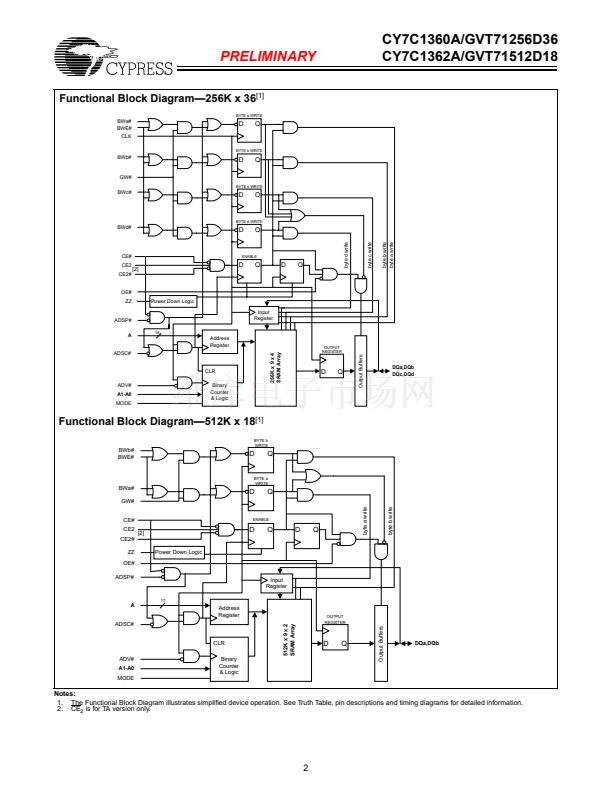
and a 2-bit counter for internal burst operation. All synchro-
nous inputs are gated by registers controlled by a posi-
tive-edge-triggered Clock Input (CLK). The synchronous in-
puts include all addresses, all data inputs, address-pipelining
Chip Enable (CE), depth-expansion Chip Enables (CE
2
and
CE
2
), burst control inputs (ADSC, ADSP and ADV), Write En-
,
ables (BWa, BWb, BWc, BWd, and BWE), and global write
(GW). However, the CE
2
chip enable input is only available for
the TA package version.
Asynchronous inputs include the Output Enable (OE) and
burst mode control (MODE). The data outputs (Q), enabled by
OE, are also asynchronous.
Addresses and chip enables are registered with either Ad-
dress Status Processor (ADSP) or Address Status Controller
(ADSC) input pins. Subsequent burst addresses can be inter-
nally generated as controlled by the Burst Advance Pin (ADV).
Address, data inputs, and write controls are registered on-chip
to initiate self-timed WRITE cycle. WRITE cycles can be one
to four bytes wide as controlled by the write control inputs.
Individual byte write allows individual byte to be written. BWa
controls DQa. BWb controls DQb. BWc controls DQc. BWd
controls DQd. BWa, BWb, BWc, and BWd can be active only
with BWE being LOW. GW being LOW causes all bytes to be
written. The x18 version only has 18 data inputs/outputs (DQa
and DQb) along with BWa and BWb (no BWc, BWd, DQc, and
DQd).
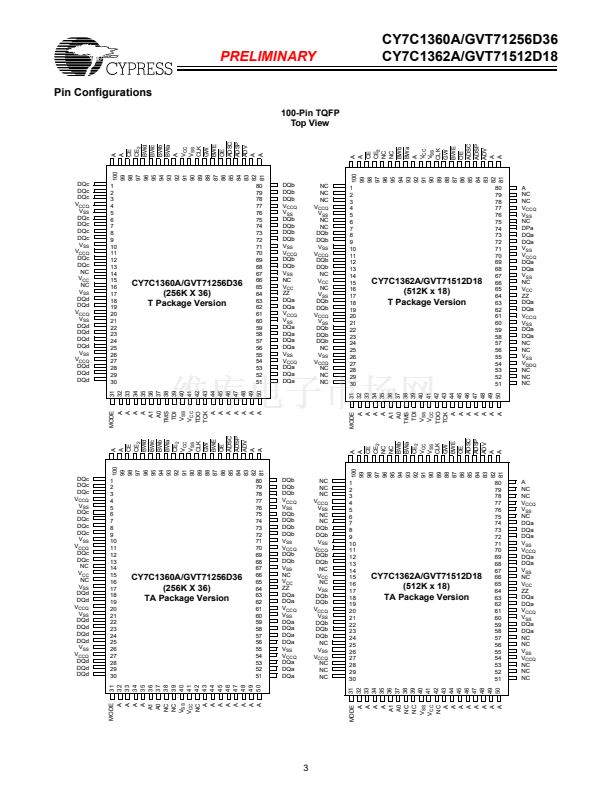
For the B and T package versions, four pins are used to imple-
ment JTAG test capabilities: Test Mode Select (TMS), Test Da-
ta-In (TDI), Test Clock (TCK), and Test Data-Out (TDO). The
JTAG circuitry is used to serially shift data to and from the
device. JTAG inputs use LVTTL/LVCMOS levels to shift data
during this testing mode of operation. The TA package version
does not offer the JTAG capability.
The
CY7C1360A/GVT71256D36
and
CY7C1362A/
GVT71512D18 operate from a +3.3V power supply. All inputs
and outputs are LVTTL compatible.
Functional Description
The Cypress Synchronous Burst SRAM family employs
high-speed, low-power CMOS designs using advanced tri-
ple-layer polysilicon, double-layer metal technology. Each
memory cell consists of four transistors and two high-valued
resistors.
The
CY7C1360A/GVT71256D36
and
CY7C1362A/
GVT71512D18 SRAMs integrate 262,144x36 and 524,288x18
SRAM cells with advanced synchronous peripheral circuitry
Selection Guide
7C1360A-225
71256D36-4.4
7C1362A-225
71512D18-4.4
Maximum Access Time (ns)
Maximum Operating Current (mA)
Maximum CMOS Standby Current (mA)
Commercial
2.5
570
10
7C1360A-200
71256D36-5
7C1362A-200
71512D18-5
3.0
510
10
7C1360A-166
71256D36-6
7C1362A-166
71512D18-6
3.5
425
10
7C1360A-150
71256D36-6.7
7C1362A-150
71512D18-6.7
3.5
380
10
Cypress Semiconductor Corporation
鈥?/div>
3901 North First Street
鈥?/div>
San Jose
鈥?/div>
CA 95134
鈥?/div>
408-943-2600
May 9, 2001








 1
1
 2
2
 3
3
 4
4
 5
5
 6
6
 7
7
 8
8
 9
9
 10
10
 11
11
 12
12
 13
13
 14
14
 15
15
 16
16
 17
17
 18
18
 19
19
 20
20
 21
21
 22
22
 23
23
 24
24
 25
25
 26
26
 27
27
