Application Note 23
Micrel
Application Note 23
MICRF001 Antenna Design Tutorial
by Tom Yestrebsky
Introduction
Every wireless system is composed of the following five
components:
鈥?Data encoder
鈥?Baseband-to-RF transducer
鈥?Antenna system
鈥?RF-to-baseband transducer
鈥?Data decoder
This is illustrated in the block diagram of Figure 1.
The MICRF001 UHF receiver IC, developed by Micrel, pro-
vides a low-cost solution for the RF-to-baseband transducer
in Figure 1, for applications in the 300MHz to 440MHz
frequency band. Integrated and discrete solutions also readily
exist for the data encoder/decoder functions and for the base-
band-to-RF transducer (commonly called the transmitter).
Undeniably, of all the elements in Figure 1, the antenna
system is the most difficult to design and optimize. There are
several reasons for this. First, many designers lack sufficient
working experience with antennas to gain an intuitive feel,
especially in low-power, low-cost applications. Antenna mea-
surement and characterization requires sophisticated and
expensive test equipment, which may not be readily avail-
able. Also, antenna analysis often relies on simplifying as-
sumptions, which may not hold in all cases, and often leads
to measurement inconsistency.
Reading this application note will not make one an antenna
expert. Antenna design and optimization is too complex and
driven by variables which are often beyond the designer鈥檚
control. To add insult to injury, the entire problem is further
complicated if the antenna is located remotely from the
receiver through a transmission line. In these cases imped-
ance matching networks may need to be designed.
Fortunately, the problem of selecting an appropriate antenna
is not as overwhelming as it seems. Most low power remote-
control wireless applications are sensitive not only to range,
but to cost and packaging constraints as well. And the most
appropriate antennas for these applications are fairly simple
structures. They can be easily characterized and compared
using some basic terms. The problem is further simplified
because antenna systems in these applications are usually
connected directly to the transmitting and receiving units.
It has been determined that the best overall antenna for such
applications is simply a 鈥減iece of wire鈥? Certainly no antenna
is less expensive, especially when the 鈥渨ire鈥?is built into the
electronic circuit board. It only remains then to choose the
form factor of this 鈥渨ire.鈥?By this we mean whether the wire is
straight, coil, or a single loop. In many instances even the
form factor is dictated by product packaging constraints. For
example, when the package must be very small and com-
pletely enclosed, a coil or loop will be the preferred choice,
assuming the range constraint can also be met.
The MICRF001 UHF receiver is designed to be connected
directly to the antennas described above and achieve range
performance adequate for most applications. Other high-
performance antennas exist, but cost constraints prohibit
their consideration in all but the highest-performance applica-
tions. This application note will only discuss relative perfor-
mance characteristics of the three most popular antennas鈥?/div>
straight wire (monopole), (helical) coil, and loop鈥攊n the
context of what is generally important to the user (range
performance, size, and ease of design). For a more thorough
treatment of the theory, consult one or more of the references
in the bibliography.
The intent of this application note is to provide the user with
sufficient guidance to develop an antenna system for the
MICRF001鈥攕imply, quickly, and with a reasonable degree
of performance鈥攅specially for inexperienced users. If after
applying the concepts discussed here, rage performance still
is not adequate, further antenna optimization may be at-
tempted; however, one should not expect significant range
improvements to come from these further efforts. Antenna
system optimization is closely linked to the 鈥渓aw of diminishing
returns.鈥?This simply means that one can derive most of the
optimum antenna performance with a modest amount of
effort, and some simple guidelines. Beyond this point, incre-
mental improvements become increasingly costly, and yield
only marginal range benefit.
Antenna System
Data
In
Data
Encoder
Baseband-to-RF
Transducer
RF-to-Baseband
Transducer
Data
Decoder
Data
Out
Figure 1. Wireless Communication System鈥擲implified Block Diagram
QwikRadio is a trademark of Micrel, Inc. The QwikRadio ICs were developed under a partnership agreement with AIT of Orlando, Florida
Micrel, Inc. 鈥?1849 Fortune Drive 鈥?San Jose, CA 95131 鈥?USA 鈥?tel + 1 (408) 944-0800 鈥?fax + 1 (408) 944-0970 鈥?http://www.micrel.com
July 1999
1
Application Note 23








 1
1
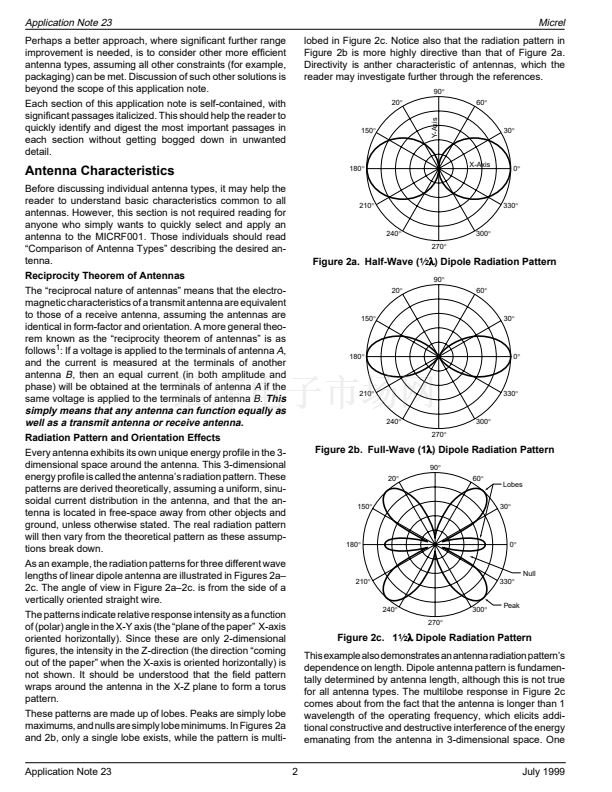 2
2
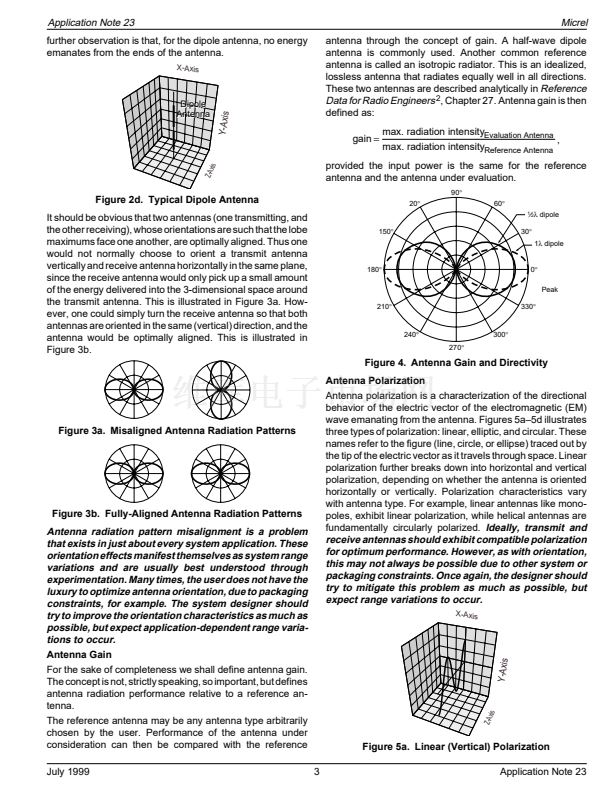 3
3
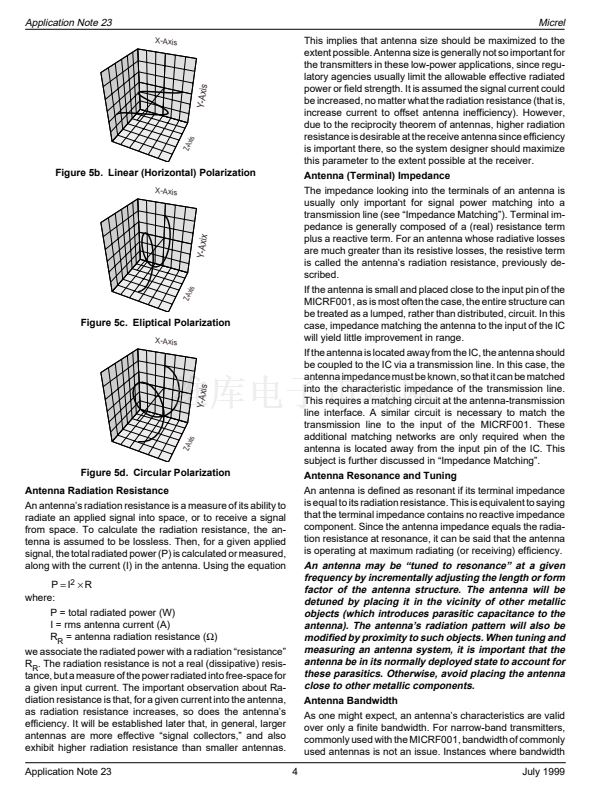 4
4
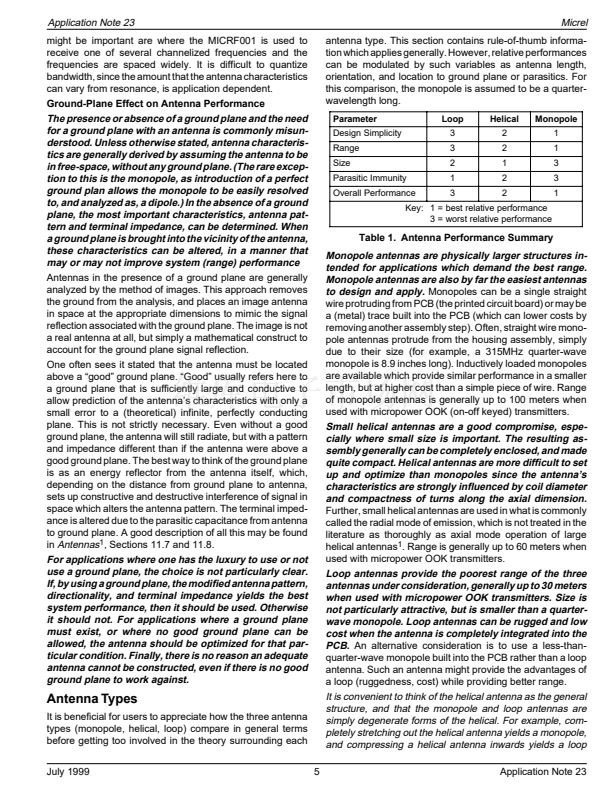 5
5
 6
6
 7
7
 8
8
