廬
APPLICATION BULLETIN
By Christian Henn, Burr-Brown International, GmbH
Mailing Address: PO Box 11400 鈥?Tucson, AZ 85734 鈥?Street Address: 6730 S. Tucson Blvd. 鈥?Tucson, AZ 85706
Tel: (602) 746-1111 鈥?Twx: 910-952-111 鈥?Telex: 066-6491 鈥?FAX (602) 889-1510 鈥?Immediate Product Info: (800) 548-6132
INTERMODULATION DISTORTION (IMD)
The intermodulation distortion (IMD) performance of
wideband, DC-coupled amplifiers is a relatively new area
for integrated operational amplifier suppliers. New progresses
in IC technology extend the application of op amps where
some years ago discrete circuits played the major role.
Methods to measure and communicate the extent of this
distortion to users have been borrowed from traditional
鈥淩F鈥?companies which have historically supplied the radar
and radio communications industries, where the importance
of it was first highlighted.
Examples of applications demanding good intermodulation
distortion include:
鈥?Radar
鈥?Satellite Communications
鈥?Digital Radio Receivers
鈥?Nuclear Particle Research
鈥?CAD Monitor Amplifier
In radar applications good IMD performance is essential,
because interference from other radars and jammers often
pollute the spectrum. For satellite communications systems,
the usable bandwidth for each transponder is limited and
multiple signals are frequency multiplicated onto one carrier
so that signals can interfere with each other when IMD
performance is low. For Digital Radio Receivers, a small
segment of a broader RF spectrum is digitized and scanned
by high-speed data signal processors. For CAD Monitor
Amplifiers and for Nuclear Particle Research test equip-
ment, the IMD or as later described the intercept point
characterize more precisely than harmonic distortion the
large signal capabilities of wideband amplifiers.
INTERMODULATION DISTORTION
IN THE OPA622 AND OPA623
The IMD test results in this application note center on new
ultra high-speed operational amplifiers available from Burr-
Brown鈥攏otably, the OPA622 voltage feedback amplifier
and the OPA623 current-feedback amplifier.
While the specifications are important and are fully tested,
the targeted market segments for these amplifiers clearly
called for superior AC performance. Enhanced testing for
these parts includes 鈥?dB bandwidth curves for various
gains and output voltage swings, group delay time, settling
time, rise time, slew rate, harmonic distortion, and IMD
performance. In the remaining sections the application note
describes the basics of intermodulation distortions, the rela-
tionship between fundamental and 3rd IMD, and shows the
test setup and test results for the OPA622 and OPA623.
HARMONIC DISTORTION
When Flash-A/D users talk about distortion they are gener-
ally concerned with the spurs introduced into the spectrum
of interest. In laboratory conditions harmonic distortion is a
major area of concern and is usually measured by inserting
a single-tone fundamental into the DUT, then looking at the
relevant frequency (2xf, 3xf) to determine the magnitude of
the harmonic tones. While this testing is useful to many
customers, it does not always appease everyone. Manufac-
turers who claim to have amplifiers with 鈥?dB bandwidth in
the tens of MHz region often test distortion at relatively low
tones. While the results are undoubtedly favorable, the user
cannot use it for a circuit design. Harmonic distortion also
neglects the magnitude of spurs from other sources. Installed
in the equipment for which it was selected, there is no
guarantee that it will be exposed to a pure spectrum as it is
for harmonic distortion measurements. In many cases the
amplifier is asked to operate in spectrally-rich environments
where intermodulation distortion properties of the amp are
of keen interest.
MATHEMATICAL DERIVATION
OF INTERMODULATION DISTORTION
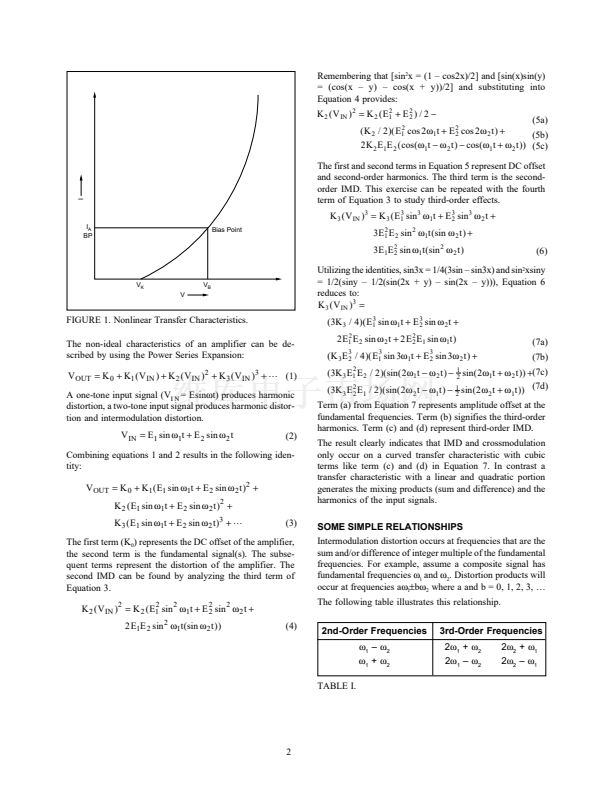
The usable dynamic range of an amplifier is limited at very
small signal levels by the noise floor and at large signal
levels by interferences between signal frequencies. Distor-
tions are caused by non-linearities in the amplitude transfer
characteristics. As shown later for producing harmonics, the
transfer curve exists of a linear and a quadratic portion and
the typical output contains not only the fundamental fre-
quency, but integer multiples of it. IMD results from the
mixing of two or more signals of different frequencies and
the transfer curve contains in addition a cubic portion. The
spurious output occurs at the sum and/or difference of
integer multiples of the input frequencies.
1
2
3
4
5
6
漏
1994 Burr-Brown Corporation
AB-194
Printed in U.S.A. April, 1994








 1
1
 2
2
 3
3
 4
4
 5
5
 6
6
 7
7
 8
8
