Mailing Address: PO Box 11400 鈥?Tucson, AZ 85734 鈥?Street Address: 6730 S. Tucson Blvd. 鈥?Tucson, AZ 85706
Tel: (520) 746-1111 鈥?Twx: 910-952-111 鈥?Telex: 066-6491 鈥?FAX (520) 889-1510 鈥?Immediate Product Info: (800) 548-6132
isolation components. We have received several requests for
isolation voltage ratings. What follows is information about
products tested using the different methods. Some of this
ing to give you the whole story.
ISOLATION VOLTAGE RATINGS鈥?/div>
WHAT DO THEY MEAN?
An isolation voltage rating is a statement about the
level of
voltage
a device can
withstand for long periods of time
with
a
high confidence
that the
barrier will not break down.
In the
initial development of a part, basic physical and materials
design determine the desired rating and long-term, high-
voltage life testing of the part verifies it. However, it鈥檚
impractical to long-term life test every isolation amplifier or
power supply that we ship. We need a test that will verify
that the part can withstand its rated voltage and give assur-
ance that it will survive that much voltage for long periods
of time.
STRESS TESTING
One way to do that is to overstress the part briefly (i.e.,
subject the part to levels significantly above its
rated
volt-
age) and then test the part at rated continuous voltage for a
short period of time. Alternatively, one can test the part at
the overstress voltage for a fixed time, such as 60 seconds
(dielectric withstand testing).
We have used both methods, depending on the intended
market applications. In either case, the philosophy is some-
thing like life testing. In much the same way as accelerated
life testing is used to identify infant mortality problems with
electronic components, the dielectric withstand testing is
used to identify problems with dielectric materials used in
isolation circuits.
The choice of overstress voltage is an important one. Many
isolation applications see not only the continuous voltage,
but also experience transient voltages. Historically, we have
used an overstress voltage, V
TEST
= (2
x
Continuous Rating)
+ 1000V. This choice is used in some UL specifications and
is appropriate for conditions where systems transients are
not well defined.
漏
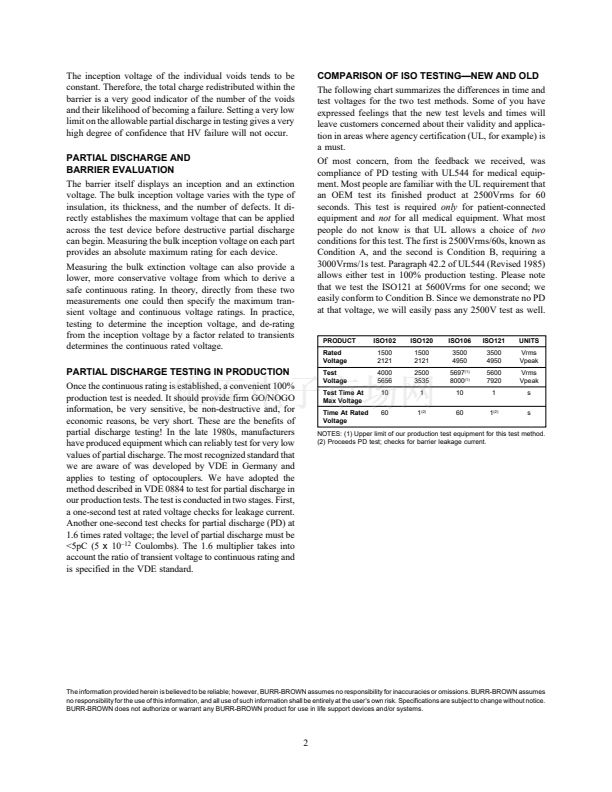
However, there are other methods of testing for high-voltage
breakdown and some have been around a long time. In 1944,
Austin and Hacket published
Internal Discharges in Dielec-
trics: Their Observation and Analysis.
Since that time, the
phenomenon they described, and now termed partial dis-
charge, has steadily gained wider acceptance in the evaluat-
ing dielectric materials. For a number of years, the manufac-
turers of power distribution equipment have used a measure-
ment of RF noise to detect the ionization that precedes high-
voltage breakdown. This method is OK for large transform-
ers or similar equipment, but it has not been sensitive
enough for small components such as those used in Burr-
Brown鈥檚 isolation amplifiers and power supplies.
Partial discharge testing is similar in concept to the RF noise
detection, and recent advances in test equipment and testing
standards now make it possible to use this much more
sensitive method with our products. Just as Burr-Brown鈥檚
products are at the forefront of technology, our use of partial
discharge testing for some products should be seen as being
on the leading edge of testing dielectric materials. We are
not abandoning the older, more accepted test standards.
However, in preparing to meet the demands for what we
believe to be a world-class testing standard, we would like
to tell you something about partial discharge, how it鈥檚 tested,
and why we believe it will become the recognized superior
method of testing dielectric materials.
PARTIAL DISCHARGE
When an isolation barrier has a defect such as an internal
void, the defect will display localized ionization when ex-
posed to high voltage. This ionization starts at one voltage
and stops at a lower voltage. These are called the inception
and extinction voltages. As high voltage is applied to the
barrier, voltage will also build up across the void. When the
inception voltage is reached, the void ionizes, shorting itself
out. When the voltage across the void drops below the
extinction voltage, ionization ceases.
This action redistributes charge within the barrier and is
known as partial discharge. If the barrier voltage continues
to rise, another partial discharge cycle begins. If the barrier
voltage is AC and is large enough, partial discharge cycles
will repeat many times during the positive and negative
peaks. If the ionization begins and continues, it can damage
the barrier, leading to failure. If the discharge does not
occur, the barrier receives no damage.
1989 Burr-Brown Corporation
AB-163A
1
Printed in U.S.A. August, 1995








 1
1
 2
2
