廬
APPLICATION BULLETIN
Mailing Address: PO Box 11400 鈥?Tucson, AZ 85734 鈥?Street Address: 6730 S. Tucson Blvd. 鈥?Tucson, AZ 85706
Tel: (602) 746-1111 鈥?Twx: 910-952-111 鈥?Telex: 066-6491 鈥?FAX (602) 889-1510 鈥?Immediate Product Info: (800) 548-6132
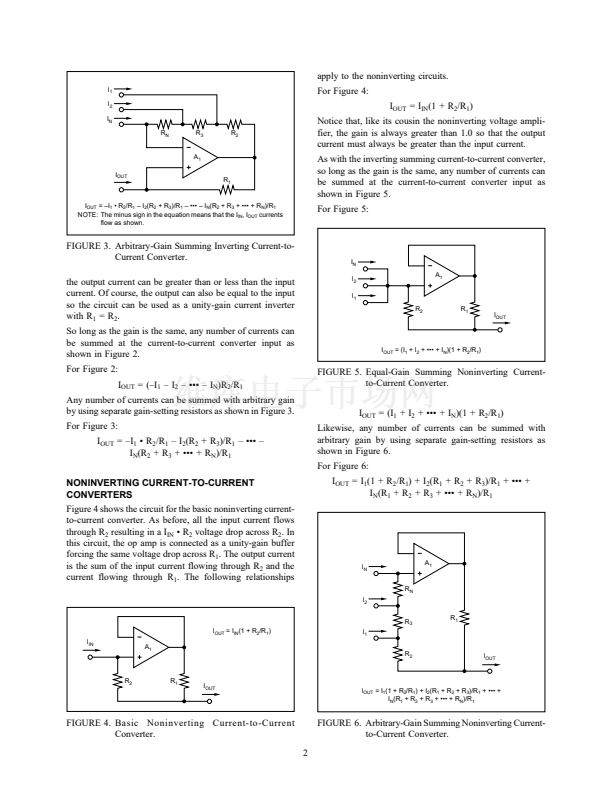
4-20mA TO 0-20mA CONVERTER AND
CURRENT SUMMING CURRENT-TO-CURRENT CONVERTERS
By R. Mark Stitt and David Kunst (602) 746-7445
Current loops have become the standard for signal transmis-
sion in the process control industry. Current loops are
insensitive to noise and are immune to errors from line
impedance. Burr-Brown offers a complete line of monolithic
4mA to 20mA current loop transmitters and receivers.
XTR101
General purpose two-wire 4-20mA current-loop transmitter.
This transmitter has an instrumentation amplifier input and
two 1mA current sources for transducer excitation and
offsetting.
XTR103
Two-wire RTD 4-20mA current-loop transmitter. Similar to
XTR101, but with internal linearization circuitry for direct
interface to RTDs (Resistance Temperature Detectors). The
XTR103 along with an RTD forms a precision temperature
to 4-20mA current loop transmitter.
XTR104
Two-wire bridge 4-20mA current-loop transmitter. Similar
to XTR101, but with shunt regulator and linearization cir-
cuitry for direct interface to resistor transducer bridges.
XTR110
Three-wire 4-20mA transmitter. The XTR110 converts a 0-
5V or 0-10V high-level input into a 0-20mA or 4-20mA
current-soruce output.
RCV420
Self-contained 4-20mA receiver. Conditions and offsets 4-
20mA input signals to give a precision 0-5V output. Con-
tains precision voltage reference, 75鈩?precision sense resis-
tor and
鹵40V
common-mode input range difference ampli-
fier.
The 4mA to 20mA current loop is the most often used
standard. Since the minimum signal current is 4mA, the
transducer and transmitter can be powered by the same two
wires used for the current loop connection. This feature
eliminates the need for a remote power supply. Also, open
circuits are easy to detect since the signal goes to 0mA.
Some systems, however, use a 0 to 20mA current loop
standard instead. To interface to these systems, the 4-20mA
漏
1
R
2
2
I
IN
A
1
I
OUT
R
1
3
4
5
I
OUT
= 鈥揑
IN
鈥?R
2
/R
1
NOTE: The minus sign in the equation means that the I
IN
, I
OUT
currents
flow as shown.
FIGURE 1. Basic Inverting Current-to-Current Converter.
XTR output must be converted to 0-20mA. This bulletin
shows the suggested circuit and also discusses summing
current-to-current converters in general.
6
INVERTING CURRENT-TO-CURRENT
CONVERTERS
Figure 1 shows the basic inverting current-to-current con-
verter. The input current all flows through R
2
resulting in an
I
IN
鈥?R
2
voltage drop across R
2
. The op amp forces the same
voltage across R
1
so that there is no voltage difference at the
op amp inputs. The I
OUT
current is therefore:
For Figure 1:
I
OUT
= 鈥揑
IN
鈥?R
2
/R
1
Notice that, like its cousin the inverting voltage amplifier,
7
8
9
1
0
Application Bulletin Number 31
I
1
I
2
I
N
R
2
1
1
1
2
A
1
I
OUT
R
1
1
3
1
4
1
5
I
OUT
= (鈥揑
1
鈥?I
2
鈥?鈥⑩€⑩€?鈥?I
N
) R
2
/R
1
NOTE: The minus sign in the equation means that the I
IN
, I
OUT
currents
flow as shown.
FIGURE 2. Equal-Gain Summing Inverting Current-to-Cur-
rent Converter.
AB-031
Printed in U.S.A. April, 1991
1
6
1991 Burr-Brown Corporation








 1
1
 2
2
 3
3
 4
4
