Plug and Play
In a Plug and Play system, all plug and Play devices are quiescent on power up and following a hardware reset, therefore,
each PnP device must be identified and configured by software before it can function.
The PnP Specification defines an access method, using standard I/O access ports and commands, that allows your software to
find PnP devices, determine resources required by each PnP device, and reconfigure PnP devices to eliminate conflicts.
When your software issues a special sequence of data writes to the standard I/O access ports, the PnP logic in each PnP
device is enabled. Once a PnP device is enabled, you can determine its resource requirements and capabilities and configure
the device as needed. The special sequence of data, which is written to the standard I/O access port, is referred to as the
Initiation Key.
The tasks of identifying all PnP devices, determining all of their resource requirements, and reconfiguring PnP devices are
covered in great detail in the PnP Specification and will not be covered here.
The goal of this Application Note is to describe for you the data contained in the Initiation Key and the procedure for issuing
the Initiation Key.
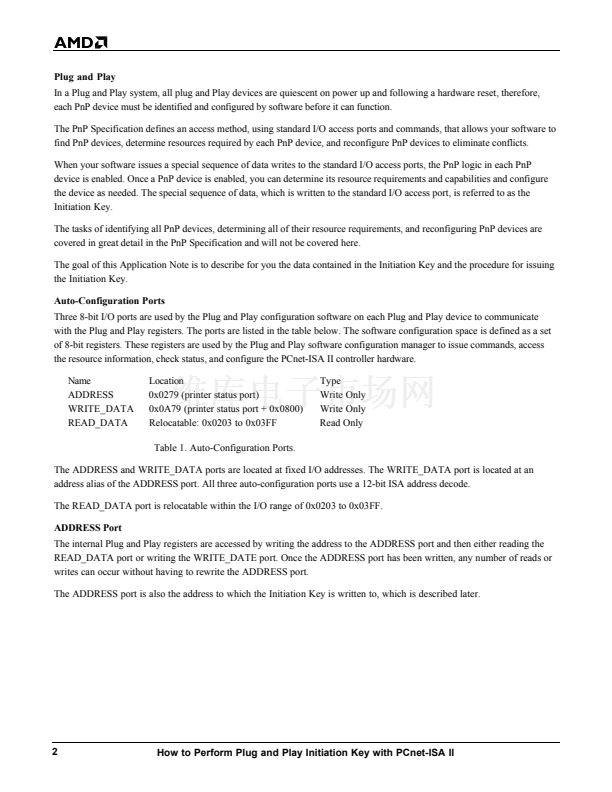
Auto-Configuration Ports
Three 8-bit I/O ports are used by the Plug and Play configuration software on each Plug and Play device to communicate
with the Plug and Play registers. The ports are listed in the table below. The software configuration space is defined as a set
of 8-bit registers. These registers are used by the Plug and Play software configuration manager to issue commands, access
the resource information, check status, and configure the PCnet-ISA II controller hardware.
Name
ADDRESS
WRITE_DATA
READ_DATA
Location
0x0279 (printer status port)
0x0A79 (printer status port + 0x0800)
Relocatable: 0x0203 to 0x03FF
Table 1. Auto-Configuration Ports.
The ADDRESS and WRITE_DATA ports are located at fixed I/O addresses. The WRITE_DATA port is located at an
address alias of the ADDRESS port. All three auto-configuration ports use a 12-bit ISA address decode.
The READ_DATA port is relocatable within the I/O range of 0x0203 to 0x03FF.
ADDRESS Port
The internal Plug and Play registers are accessed by writing the address to the ADDRESS port and then either reading the
READ_DATA port or writing the WRITE_DATE port. Once the ADDRESS port has been written, any number of reads or
writes can occur without having to rewrite the ADDRESS port.
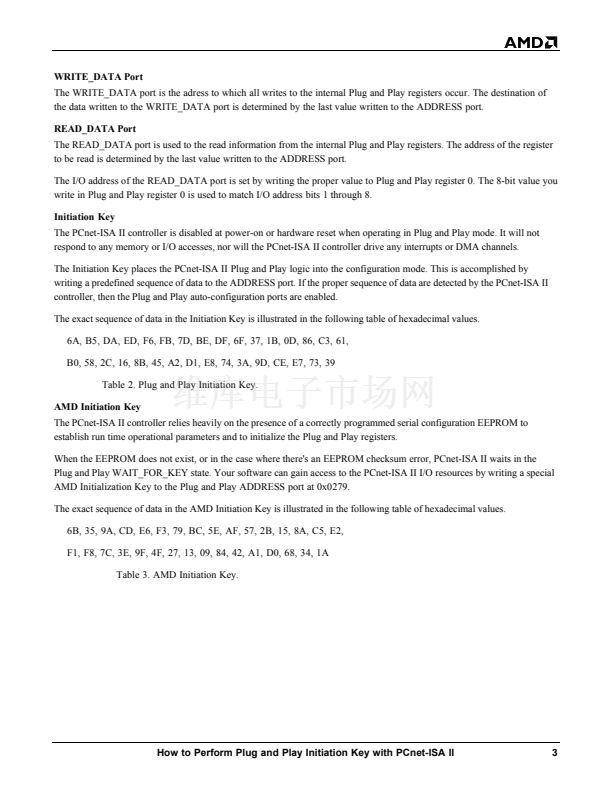
The ADDRESS port is also the address to which the Initiation Key is written to, which is described later.
Type
Write Only
Write Only
Read Only
2
How to Perform Plug and Play Initiation Key with PCnet-ISA II








 1
1
 2
2
 3
3
 4
4
 5
5
 6
6
 7
7
 8
8
 9
9
 10
10
 11
11
 12
12
 13
13
