鈭?/div>
t
i=1
r
As shown, each factor of the above sum is distributed X
2(2)
.
Therefore, by the reproductive property of X
2
the summation
is also distributed X
2
with r times 2 degrees of freedom, X
2
(2r) as stated.
AND FINALLY
The concepts of MTTF, failure rate and reliability have been
defined, discussed and justified. In general, the time units of
device 鈥?hours have been used. With this dimension, failure
rate can be interpreted as the frequency with which failures
can be expected to occur. This description works well with
the experimental estimation of the unknown parameters and
provides an intuitive perspective. However, reliability esti-
mation is, in essence, a probabilistic science and the Weibull
equations are, in essence, probability equations. As a prob-
ability equation, failure rate becomes the probability of
failure per hour, not per device 鈥?hour. The reader is
encouraged to give this distinction some thought.
We perform our life testing at elevated temperatures in order
to accelerate failure mechanisms which might result in
device failure. Our reliability reports generally supply MTTF
estimates scaled over a range of temperatures appropriate to
application environments. The Arehnius equation with an
activation energy selected to represent typical failure mecha-
nisms is employed to generate the tables.
Here at Burr-Brown we use a spreadsheet program to calcu-
late and record the results of life tests. Constant failure rate
is presumed. This presumption should always be verified. It
may not be unreasonable to interpret MTTF as the mean
time to the first failure even if the failure rate is not constant.
However, failure rate and reliability predictions based on
that MTTF will be wrong.
APPENDIX A
dexp (鈥撐眡
尾
) / dx
=
exp (鈥撐眡
尾
) d(鈥撐眡
尾
) / dx
鈭?/div>
t
i
=1
r
r
i
=
0
藴
using
偽
to indicate the approximation,
1
=
藴
偽
鈭?/div>
t
i
=1
i
r
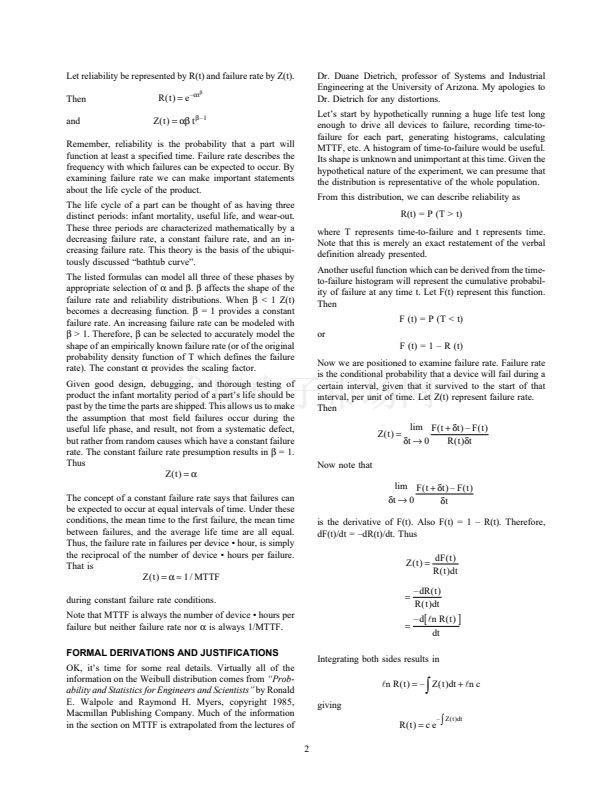
This equation shows that 1/偽 can be estimated by dividing
the accumulated test time for all of the tested devices by the
total number of failures. This agrees with the original defi-
nition of MTTF.
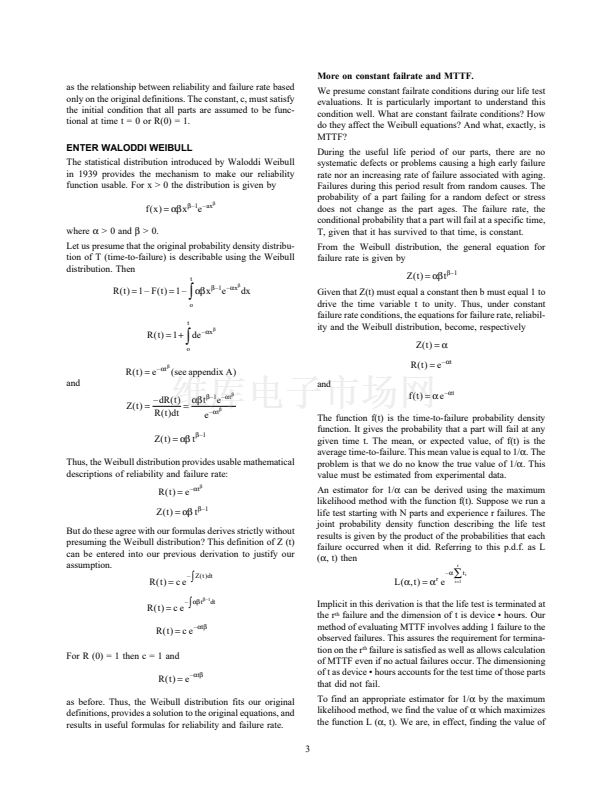
Understanding the chi-square, X
2
, confidence interval calcu-
lation requires recognition that given the random variable
for time-to-failure, T, has distribution
f (t)
= 偽e
鈥?/div>
偽t
then the random variable V described by
V
=
2偽
鈭?/div>
t
i=1
r
i
is distributed X
2
with 2r degrees of freedom, X
2
(2r). There-
fore, for a specified confidence level 莽
2偽
鈭?/div>
t
i=1
r
i
>
X
2
(2r,味)
and the upper confidence limit for MTTF becomes
2 t
i
1
i=1
<
=
MTTF
偽 蠂
2
(2r,味)
鈭?/div>
r
=
exp (鈥撐眡
尾
) (鈥撐蔽? (x
尾鈥?
)
=
鈥?/div>
偽尾x
尾鈥?
exp (鈥撐眡
尾
)
therefore replacing
鈥?/div>
which, with r equal to the number of observed failures + 1,
is the actual formula we use for MTTF.
To justify the X distribution of the random variable V used
above, apply the transformation of variable
2
鈭?/div>
t
0
偽尾x
尾
鈥?
exp (鈥撐眡
尾
) dx
=
鈥?/div>
V
/
=
2偽T,
to f(t) which results in
f (v)
= 偽e
2
dT
1
/
=
dV
2偽
V
鈭?/div>
d exp (鈥撐眡 ) / dx dx
=
鈥?/div>
鈭?/div>
d exp (鈥撐眡 )
尾
0
t
t
尾
0
and
R(t)
=
1
+
鈭?/div>
d exp (鈥撐眡
0
t
0
t
尾
)
鈥撐?/div>
V
2偽
1
1
鈥?/div>
=
e
2
2偽 2
=
1
+
exp(鈥撐眡
尾
) |
2(2)
which is distributed X with 2 degrees of freedom, X
Appendix B).
(see
4
=
1
+
exp(鈥撐眛
尾
) 鈥?1
AB-059相關型號PDF文件下載
-
型號
版本
描述
廠商
下載
-
英文版
AB-001 - INCREASING INA117 DIFFERENTIAL INPUT RANGE
ETC
-
英文版
AB-002 - MAKE A PRECISION CURRENT SOURCE OR CURRENT SINK
ETC
-
英文版
AB-003 - VOLTAGE-REFERENCE FILTERS
ETC
-
英文版
AB-004 - MAKE A PRECISION -10V REFERENCE
ETC
-
英文版
AB-005 - Make A Precision -10V Reference
ETC
-
英文版
AB-006 - Make a -10V to +10V Adjustable Precision Voltage So...
ETC
-
英文版
AB-007 - CLASSICAL OP AMP OR CURRENT-FEEDBACK OP AMP?
ETC
-
英文版
AB-008 - AC COUPLING INSTRUMENTATION AND DIFFERENCE AMPLIFIE...
ETC
-
英文版
AB-009 - SINGLE-SUPPLY OPERATION OF ISOLATION AMPLIFIERS
ETC
-
英文版
AB-010 - -200V DIFFERENCE AMPLIFIER WITH COMMON-MODE VOLTAGE...
ETC
-
英文版
AB-011 - LOW POWER SUPPLY VOLTAGE OPERATION OF REF102 10.0V ...
ETC
-
英文版
AB-012 - BOOST ISO120 BANDWIDTH TO MORE THAN 100kHz
ETC
-
英文版
AB-013 - INCREASING ADC603 INPUT RANGE
ETC
-
英文版
AB-014 - INPUT OVERLOAD PROTECTION FOR THE RCV420 4-20mA CUR...
ETC
-
英文版
AB-015 - EXTENDING THE COMMON-MODE RANGE OF DIFFERENCE AMPLI...
ETC
-
英文版
AB-016 - BOOST AMPLIFIER OUTPUT SWING WITH SIMPLE MODIFICATI...
ETC
-
英文版
AB-017 - Sallen-Key Low-Pass Filter Design Program
ETC
-
英文版
AB-018 - 0 TO 20mA RECEIVER USING RCV420
ETC
-
英文版
AB-019 - USING THE ADS7800 12 BIT ADC WITH UNIPOLAR INPUT SI...
ETC
-
英文版
AB-020 - BURR-BROWN SPICE BASED MACROMODELS. REV. F
ETC









 1
1
 2
2
 3
3
 4
4
 5
5
