More on constant failrate and MTTF.
as the relationship between reliability and failure rate based
only on the original definitions. The constant, c, must satisfy
the initial condition that all parts are assumed to be func-
tional at time t = 0 or R(0) = 1.
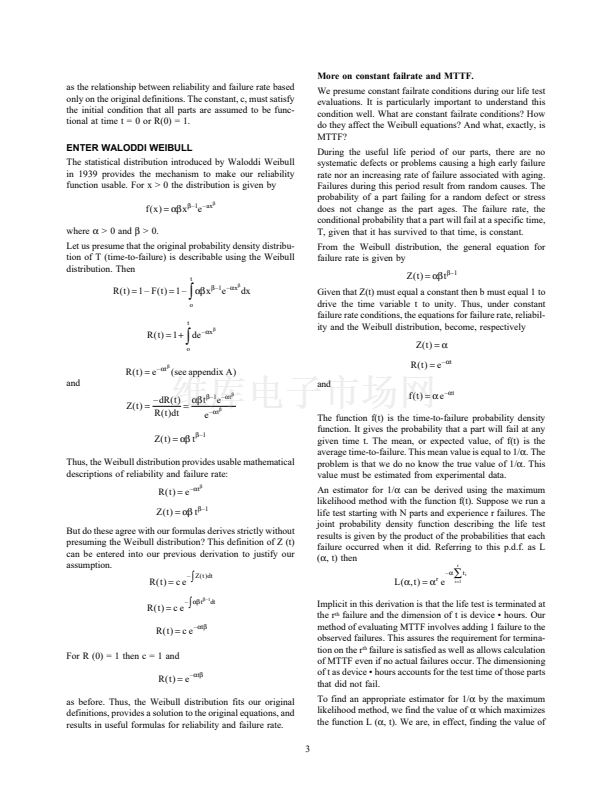
ENTER WALODDI WEIBULL
The statistical distribution introduced by Waloddi Weibull
in 1939 provides the mechanism to make our reliability
function usable. For x > 0 the distribution is given by
We presume constant failrate conditions during our life test
evaluations. It is particularly important to understand this
condition well. What are constant failrate conditions? How
do they affect the Weibull equations? And what, exactly, is
MTTF?
During the useful life period of our parts, there are no
systematic defects or problems causing a high early failure
rate nor an increasing rate of failure associated with aging.
Failures during this period result from random causes. The
probability of a part failing for a random defect or stress
does not change as the part ages. The failure rate, the
conditional probability that a part will fail at a specific time,
T, given that it has survived to that time, is constant.
From the Weibull distribution, the general equation for
failure rate is given by
f (x)
= 偽尾x
尾鈥?
e
鈥揳x
where
偽
> 0 and
尾
> 0.
尾
Let us presume that the original probability density distribu-
tion of T (time-to-failure) is describable using the Weibull
distribution. Then
R(t)
=
1 鈥?F(t)
=
1 鈥?/div>
偽尾x
尾鈥?
e
鈥撐眡
dx
o
鈭?/div>
t
尾
Z(t)
= 偽尾t
尾鈥?
Given that Z(t) must equal a constant then b must equal 1 to
drive the time variable t to unity. Thus, under constant
failure rate conditions, the equations for failure rate, reliabil-
ity and the Weibull distribution, become, respectively
Z(t)
= 偽
R(t)
=
1
+
de
鈥撐眡
o
鈭?/div>
t
尾
R(t)
=
e
and
鈥撐眛
尾
(see appendix A)
and
尾
R(t)
=
e
鈥撐眛
鈥揹R(t)
偽尾t
尾鈥?
e
鈥撐眛
Z(t)
=
=
尾
R(t)dt
e
鈥撐眛
Z(t)
= 偽尾
t
尾鈥?
f(t)
= 偽
e
鈥撐眛
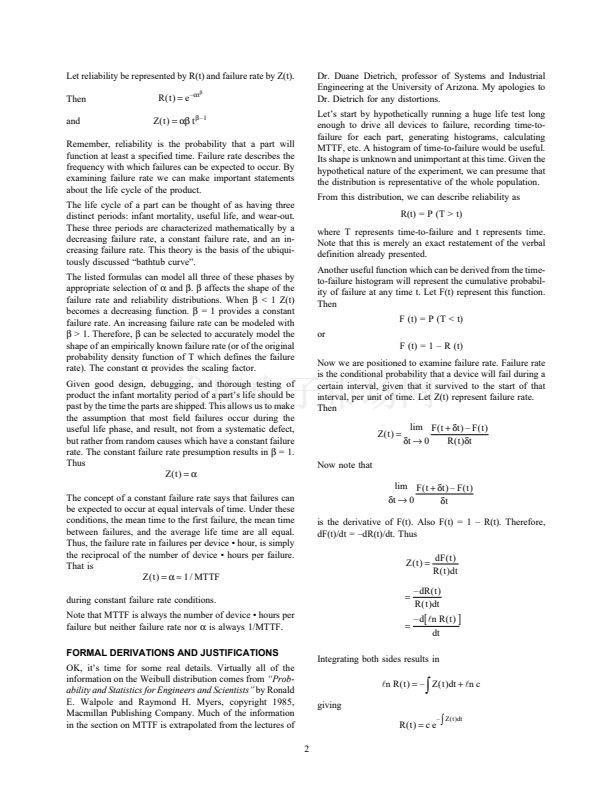
The function f(t) is the time-to-failure probability density
function. It gives the probability that a part will fail at any
given time t. The mean, or expected value, of f(t) is the
average time-to-failure. This mean value is equal to 1/偽. The
problem is that we do no know the true value of 1/偽. This
value must be estimated from experimental data.
An estimator for 1/偽 can be derived using the maximum
likelihood method with the function f(t). Suppose we run a
life test starting with N parts and experience r failures. The
joint probability density function describing the life test
results is given by the product of the probabilities that each
failure occurred when it did. Referring to this p.d.f. as L
(偽, t) then
Thus, the Weibull distribution provides usable mathematical
descriptions of reliability and failure rate:
R(t)
=
e
鈥撐眛
尾
Z(t)
= 偽尾
t
尾鈥?
But do these agree with our formulas derives strictly without
presuming the Weibull distribution? This definition of Z (t)
can be entered into our previous derivation to justify our
assumption.
R(t)
=
c e
R(t)
=
c e
鈥?Z(t)dt
鈭?/div>
L(偽, t)
= 偽
e
r
鈥撐?/div>
鈭?/div>
t
i
i=1
r
鈥?/div>
偽尾t
尾鈥?
dt
鈭?/div>
R(t)
=
c e
鈥撐眛尾
For R (0) = 1 then c = 1 and
R(t)
=
e
鈥撐眛尾
as before. Thus, the Weibull distribution fits our original
definitions, provides a solution to the original equations, and
results in useful formulas for reliability and failure rate.
3
Implicit in this derivation is that the life test is terminated at
the r
th
failure and the dimension of t is device 鈥?hours. Our
method of evaluating MTTF involves adding 1 failure to the
observed failures. This assures the requirement for termina-
tion on the r
th
failure is satisfied as well as allows calculation
of MTTF even if no actual failures occur. The dimensioning
of t as device 鈥?hours accounts for the test time of those parts
that did not fail.
To find an appropriate estimator for 1/偽 by the maximum
likelihood method, we find the value of
偽
which maximizes
the function L (偽, t). We are, in effect, finding the value of
AB-059相關(guān)型號PDF文件下載
-
型號
版本
描述
廠商
下載
-
英文版
AB-001 - INCREASING INA117 DIFFERENTIAL INPUT RANGE
ETC
-
英文版
AB-002 - MAKE A PRECISION CURRENT SOURCE OR CURRENT SINK
ETC
-
英文版
AB-003 - VOLTAGE-REFERENCE FILTERS
ETC
-
英文版
AB-004 - MAKE A PRECISION -10V REFERENCE
ETC
-
英文版
AB-005 - Make A Precision -10V Reference
ETC
-
英文版
AB-006 - Make a -10V to +10V Adjustable Precision Voltage So...
ETC
-
英文版
AB-007 - CLASSICAL OP AMP OR CURRENT-FEEDBACK OP AMP?
ETC
-
英文版
AB-008 - AC COUPLING INSTRUMENTATION AND DIFFERENCE AMPLIFIE...
ETC
-
英文版
AB-009 - SINGLE-SUPPLY OPERATION OF ISOLATION AMPLIFIERS
ETC
-
英文版
AB-010 - -200V DIFFERENCE AMPLIFIER WITH COMMON-MODE VOLTAGE...
ETC
-
英文版
AB-011 - LOW POWER SUPPLY VOLTAGE OPERATION OF REF102 10.0V ...
ETC
-
英文版
AB-012 - BOOST ISO120 BANDWIDTH TO MORE THAN 100kHz
ETC
-
英文版
AB-013 - INCREASING ADC603 INPUT RANGE
ETC
-
英文版
AB-014 - INPUT OVERLOAD PROTECTION FOR THE RCV420 4-20mA CUR...
ETC
-
英文版
AB-015 - EXTENDING THE COMMON-MODE RANGE OF DIFFERENCE AMPLI...
ETC
-
英文版
AB-016 - BOOST AMPLIFIER OUTPUT SWING WITH SIMPLE MODIFICATI...
ETC
-
英文版
AB-017 - Sallen-Key Low-Pass Filter Design Program
ETC
-
英文版
AB-018 - 0 TO 20mA RECEIVER USING RCV420
ETC
-
英文版
AB-019 - USING THE ADS7800 12 BIT ADC WITH UNIPOLAR INPUT SI...
ETC
-
英文版
AB-020 - BURR-BROWN SPICE BASED MACROMODELS. REV. F
ETC








 1
1
 2
2
 3
3
 4
4
 5
5
