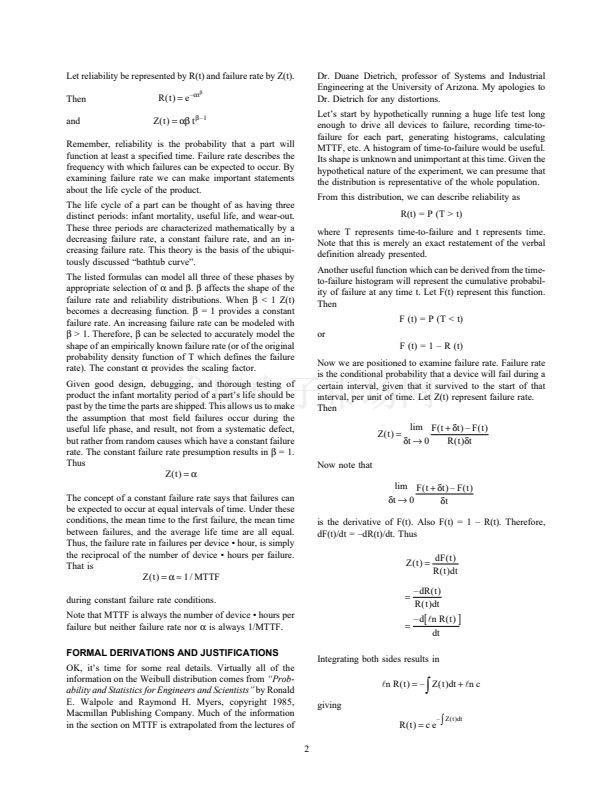
Let reliability be represented by R(t) and failure rate by Z(t).
Then
and
R(t)
=
e
鈥撐眛
尾
Dr. Duane Dietrich, professor of Systems and Industrial
Engineering at the University of Arizona. My apologies to
Dr. Dietrich for any distortions.
Let鈥檚 start by hypothetically running a huge life test long
enough to drive all devices to failure, recording time-to-
failure for each part, generating histograms, calculating
MTTF, etc. A histogram of time-to-failure would be useful.
Its shape is unknown and unimportant at this time. Given the
hypothetical nature of the experiment, we can presume that
the distribution is representative of the whole population.
From this distribution, we can describe reliability as
R(t) = P (T > t)
where T represents time-to-failure and t represents time.
Note that this is merely an exact restatement of the verbal
definition already presented.
Another useful function which can be derived from the time-
to-failure histogram will represent the cumulative probabil-
ity of failure at any time t. Let F(t) represent this function.
Then
F (t) = P (T < t)
or
F (t) = 1 鈥?R (t)
Now we are positioned to examine failure rate. Failure rate
is the conditional probability that a device will fail during a
certain interval, given that it survived to the start of that
interval, per unit of time. Let Z(t) represent failure rate.
Then
Z(t)
= 偽尾
t
尾
鈥?
Remember, reliability is the probability that a part will
function at least a specified time. Failure rate describes the
frequency with which failures can be expected to occur. By
examining failure rate we can make important statements
about the life cycle of the product.
The life cycle of a part can be thought of as having three
distinct periods: infant mortality, useful life, and wear-out.
These three periods are characterized mathematically by a
decreasing failure rate, a constant failure rate, and an in-
creasing failure rate. This theory is the basis of the ubiqui-
tously discussed 鈥渂athtub curve鈥?
The listed formulas can model all three of these phases by
appropriate selection of
偽
and
尾. 尾
affects the shape of the
failure rate and reliability distributions. When
尾
< 1 Z(t)
becomes a decreasing function.
尾
= 1 provides a constant
failure rate. An increasing failure rate can be modeled with
尾
> 1. Therefore,
尾
can be selected to accurately model the
shape of an empirically known failure rate (or of the original
probability density function of T which defines the failure
rate). The constant
偽
provides the scaling factor.
Given good design, debugging, and thorough testing of
product the infant mortality period of a part鈥檚 life should be
past by the time the parts are shipped. This allows us to make
the assumption that most field failures occur during the
useful life phase, and result, not from a systematic defect,
but rather from random causes which have a constant failure
rate. The constant failure rate presumption results in
尾
= 1.
Thus
Z(t)
= 偽
The concept of a constant failure rate says that failures can
be expected to occur at equal intervals of time. Under these
conditions, the mean time to the first failure, the mean time
between failures, and the average life time are all equal.
Thus, the failure rate in failures per device 鈥?hour, is simply
the reciprocal of the number of device 鈥?hours per failure.
That is
Z(t)
= 偽 鈮?/div>
1 / MTTF
during constant failure rate conditions.
Note that MTTF is always the number of device 鈥?hours per
failure but neither failure rate nor
偽
is always 1/MTTF.
FORMAL DERIVATIONS AND JUSTIFICATIONS
OK, it鈥檚 time for some real details. Virtually all of the
information on the Weibull distribution comes from
鈥淧rob-
ability and Statistics for Engineers and Scientists鈥?/div>
by Ronald
E. Walpole and Raymond H. Myers, copyright 1985,
Macmillan Publishing Company. Much of the information
in the section on MTTF is extrapolated from the lectures of
2
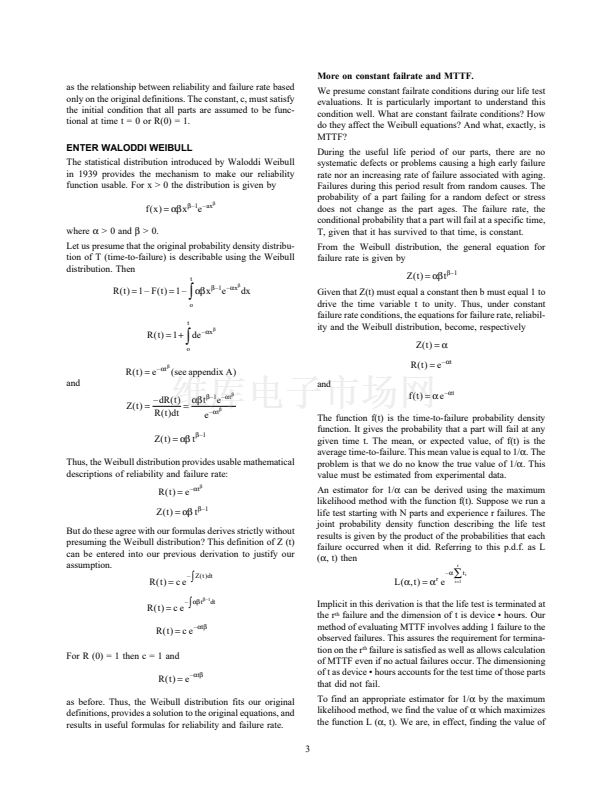
Z(t)
=
Now note that
lim F(t
+ 未t)
鈥?F(t)
未t 鈫?/div>
0
R(t)未t
lim F(t
+ 未t)
鈥?F(t)
未t 鈫?/div>
0
未t
is the derivative of F(t). Also F(t) = 1 鈥?R(t). Therefore,
dF(t)/dt = 鈥揹R(t)/dt. Thus
Z(t)
=
dF(t)
R(t)dt
=
=
鈥揹R(t)
R(t)dt
鈥揹
[
ln
R(t)
]
dt
Integrating both sides results in
ln
R(t)
=
鈥?Z(t)dt
+
ln
c
鈭?/div>
giving
R(t)
=
c e
鈥?Z(t)dt
鈭?/div>
prev
next
AB-059相關(guān)型號PDF文件下載
-
型號
版本
描述
廠商
下載
-
英文版
AB-001 - INCREASING INA117 DIFFERENTIAL INPUT RANGE
ETC
-
英文版
AB-002 - MAKE A PRECISION CURRENT SOURCE OR CURRENT SINK
ETC
-
英文版
AB-003 - VOLTAGE-REFERENCE FILTERS
ETC
-
英文版
AB-004 - MAKE A PRECISION -10V REFERENCE
ETC
-
英文版
AB-005 - Make A Precision -10V Reference
ETC
-
英文版
AB-006 - Make a -10V to +10V Adjustable Precision Voltage So...
ETC
-
英文版
AB-007 - CLASSICAL OP AMP OR CURRENT-FEEDBACK OP AMP?
ETC
-
英文版
AB-008 - AC COUPLING INSTRUMENTATION AND DIFFERENCE AMPLIFIE...
ETC
-
英文版
AB-009 - SINGLE-SUPPLY OPERATION OF ISOLATION AMPLIFIERS
ETC
-
英文版
AB-010 - -200V DIFFERENCE AMPLIFIER WITH COMMON-MODE VOLTAGE...
ETC
-
英文版
AB-011 - LOW POWER SUPPLY VOLTAGE OPERATION OF REF102 10.0V ...
ETC
-
英文版
AB-012 - BOOST ISO120 BANDWIDTH TO MORE THAN 100kHz
ETC
-
英文版
AB-013 - INCREASING ADC603 INPUT RANGE
ETC
-
英文版
AB-014 - INPUT OVERLOAD PROTECTION FOR THE RCV420 4-20mA CUR...
ETC
-
英文版
AB-015 - EXTENDING THE COMMON-MODE RANGE OF DIFFERENCE AMPLI...
ETC
-
英文版
AB-016 - BOOST AMPLIFIER OUTPUT SWING WITH SIMPLE MODIFICATI...
ETC
-
英文版
AB-017 - Sallen-Key Low-Pass Filter Design Program
ETC
-
英文版
AB-018 - 0 TO 20mA RECEIVER USING RCV420
ETC
-
英文版
AB-019 - USING THE ADS7800 12 BIT ADC WITH UNIPOLAR INPUT SI...
ETC
-
英文版
AB-020 - BURR-BROWN SPICE BASED MACROMODELS. REV. F
ETC








 1
1
 2
2
 3
3
 4
4
 5
5
