鈥?/div>
T2L FAST input and output
Pulse width detection stable and precise
14-pin DIP package
Leads 鈥?thru-hole, J, Gull Wing or Tucked
Available in pulse widths from 5 to 200ns
8 T2L fan-out capacity
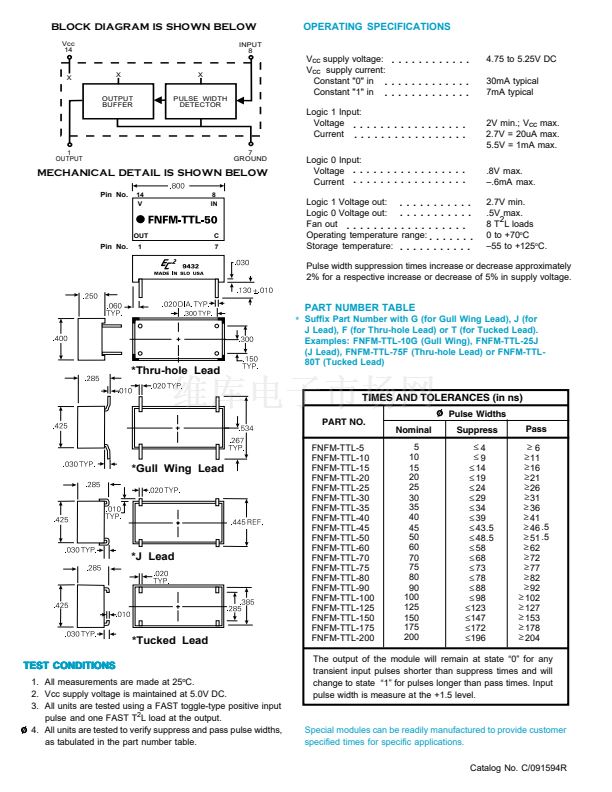
pulse width recognition is maintained as shown in the accompanying
part number table, when tested under the "Test Conditions" shown.
Temperature coefficient is less than 鹵800ppm/
0
C over the operating
temperature range of 0 to +70
0
C.
These noise filter modules are of hybrid construction utilizing the
proven technologies of active integrated circuitry and of passive
networks utilizing capacitive, inductive and resistive elements. The
MTBF on these modules, when calculated per MIL-HDBK-217 for a
50
0
C ground fixed environment, is in excess of 3.5 million hours.
housing, molded of flame-proof Diallyl Phthalate per MIL-M-14,
Type SDG-F, and are fully encapsulated in epoxy resin. Leads meet
the solderability requirements of MIL-STD-202, Method 208. Corner
standoffs on the housing of the thru-hole lead version and lead
design of the surface mount versions provide positive standoff from
the printed circuit board to permit solder-fillet formation and flush
cleaning of solder-flux residues for improved reliability.
Marking consists of the manufacturer's name, logo (EC2), part
number, terminal identification and date code of manufacture. All
marking is applied by silk screen process using white epoxy paint in
accordance with MIL-STD-130, to meet the permanency of identifi-
cation required by MIL-STD-202, Method 215.
design notes
The "DIP Series" Logic Noise Filter Modules developed by
Engineered Components Company has been designed for use in
T
2
L systems employing data pulses of either a fixed width or a
minimum width. The filter module will produce a 鈥?鈥?at the output,
without significant change in width, only when a 鈥?鈥?appears at the
input for greater than the specified pulse width; all shorter pulses
will be suppressed. This operation will effectively eliminate sources
of stray noise pulses and should prove particularly effective in
eliminating transients created by crosstalk from leading edges of
fast rise time pulses.
The FNFM-TTL is offered in 20 pulse widths from 5ns to 200ns
for optimum noise pulse rejection in varous systems. Tolerance on








 1
1
 2
2
